
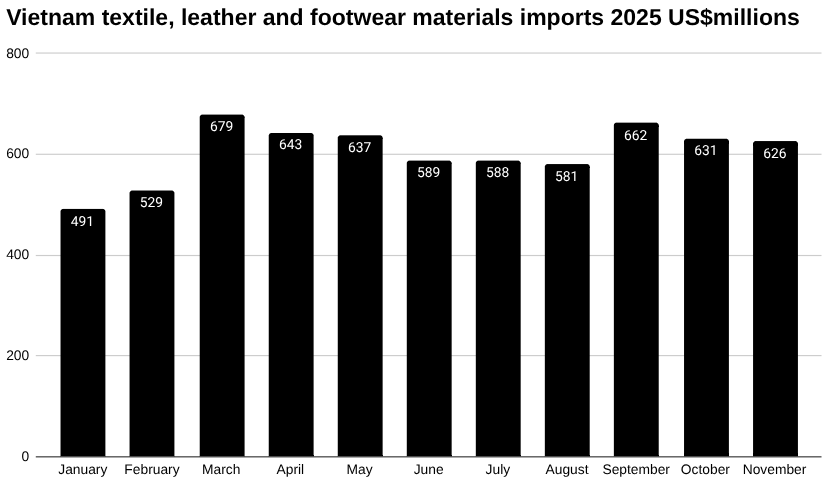
Vietnam imported textile, leather and footwear materials to the tune of US$626 million in November, down from US$631 million in October, a change of -0.77 percent, according to preliminary data from Vietnam’s General Department of Customs.
Year to date, Vietnam had imported US$6,682 million worth of textile, leather and footwear materials by the end of November.
China accounted for US$360 million worth of Vietnam’s textile, leather and footwear materials imports in November. This was up from US$359 million in textile, leather and footwear materials imports in October, a change of 0.35 percent. Year to date, China has shipped US$3,934 million worth of textile, leather and footwear materials to Vietnam.
After China was the USA making up US$42 million worth of Vietnam’s textile, leather and footwear materials imports in November. This was up from US$38 million in textile, leather and footwear materials imports in October, a change of 10.08 percent. Year to date, USA has shipped US$421 million worth of textile, leather and footwear materials to Vietnam.
Next was South Korea contributing US$37 million worth of Vietnam’s textile, leather and footwear materials imports in November. This was up from US$31 million in textile, leather and footwear materials imports in October, a change of 19.78 percent. Year to date, South Korea has shipped US$389 million worth of textile, leather and footwear materials to Vietnam.
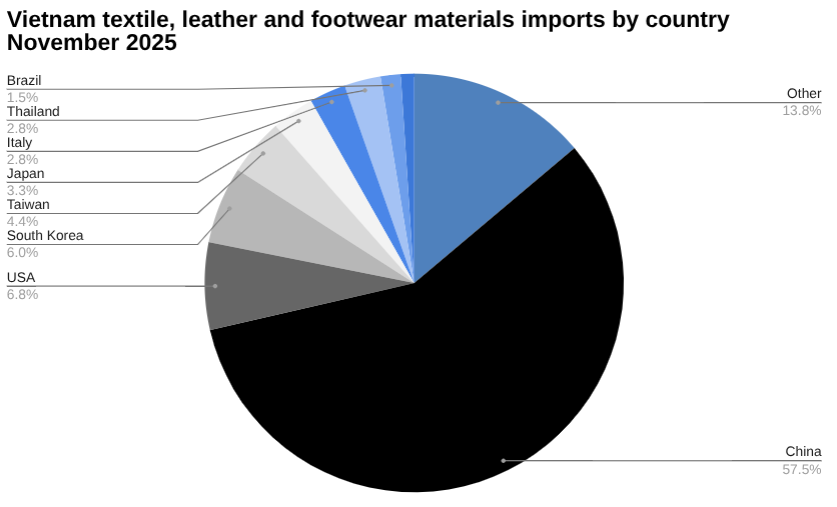
Following South Korea was Taiwan representing US$28 million worth of Vietnam’s textile, leather and footwear materials imports in November. This was up from US$27 million in textile, leather and footwear materials imports in October, a change of 2.07 percent. Year to date, Taiwan has shipped US$320 million worth of textile, leather and footwear materials to Vietnam.
Rounding out the top five was Japan constituting US$21 million worth of Vietnam’s textile, leather and footwear materials imports in November. This was down from US$26 million in textile, leather and footwear materials imports in October, a change of 20.20 percent. Year to date, Japan has shipped US$252 million worth of textile, leather and footwear materials to Vietnam.
Learn more about accessing Vietnam’s consumer market→
Vietnam imports of textile, leather and footwear materials in November, US$m
| November | October | MoM | YTD | |
| Total | 626.06 | 630.92 | -0.77% | 6,682.22 |
| Other | 80.22 | 79.72 | 0.63% | 597.75 |
| China | 360.20 | 358.94 | 0.35% | 3,934.20 |
| USA | 42.28 | 38.40 | 10.08% | 420.70 |
| South Korea | 37.33 | 31.16 | 19.78% | 389.10 |
| Taiwan | 27.62 | 27.06 | 2.07% | 320.44 |
| Japan | 20.65 | 25.87 | -20.20% | 251.83 |
| Italy | 17.62 | 19.52 | -9.72% | 214.05 |
| Thailand | 17.59 | 25.09 | -29.88% | 288.67 |
| Brazil | 9.68 | 9.59 | 1.00% | 106.62 |
| Cambodia | 6.44 | 9.52 | -32.32% | 80.88 |
| India | 6.44 | 6.05 | 6.47% | 77.99 |
| Indonesia | 5.73 | 6.56 | -12.70% | 59.59 |
| Argentina | 3.07 | 3.40 | -9.75% | 37.59 |
| Hong Kong | 2.75 | 3.04 | -9.59% | 48.55 |
| Germany | 2.40 | 2.72 | -11.71% | 23.92 |
| Pakistan | 2.29 | 3.24 | -29.16% | 26.19 |
| Malaysia | 2.09 | 2.32 | -9.94% | 20.70 |
| UK | 0.96 | 1.19 | -19.30% | 13.47 |
| Spain | 0.84 | 1.25 | -32.43% | 7.91 |
| Australia | 0.80 | 0.56 | 42.51% | 10.32 |
| France | 0.70 | 1.98 | -64.44% | 9.63 |
| New Zealand | 0.47 | 1.26 | -62.41% | 7.55 |
| Netherlands | 0.33 | 1.52 | -77.95% | 5.56 |
| Bangladesh | 0.17 | 0.49 | -64.55% | 7.40 |
| Austria | 0.10 | 0.09 | 17.35% | 1.78 |
| Canada | 0.06 | 0.02 | 216.50% | 0.51 |
| Singapore | 0.02 | 0.04 | -46.55% | 0.41 |
| Denmark | 0.00 | 0.00 | 0.00% | 0.71 |
| Poland | 0.00 | 0.00 | 0.00% | 1.29 |
Listed garment & textile companies
These companies are listed on the Ho Chi Minh City Stock Exchange.
Everpia JSC
Everpia JSC (EVE) manufactures bedding, home textiles, and insulation materials under brands such as Everon.
EVE closed at VND 10,100 on Friday down 0.4 percent with 412,000 shares traded, worth VND 422 million.
Foreign ownership in EVE is currently capped at 100.0 percent, with current foreign ownership sitting at 68.1 percent.
Song Hong Garment JSC
Song Hong Garment JSC (MSH) manufactures and exports garments and textiles for global fashion brands.
MSH closed at VND 33,450 on Friday down 0.2 percent with 2,207,000 shares traded, worth VND 7,370 million.
Foreign ownership in MSH is currently capped at 50.0 percent, with current foreign ownership sitting at 5.3 percent.
Thanh Cong Textile Garment Investment Trading JSC
Thanh Cong Textile Garment Investment Trading JSC (TCM) manufactures and exports garments, yarn, and textiles.
TCM closed at VND 26,600 on Friday down 0.55 percent with 11,249,000 shares traded, worth VND 30,189 million.
Foreign ownership in TCM is currently capped at 50.0 percent, with current foreign ownership sitting at 48.4 percent.
Explore opening a trading account in Vietnam→
Vietnam’s textiles and garments news
Recent developments in textiles and garments in Vietnam include:
Strike action garment factory
Hundreds of garment workers at Thien Dieu Company in Dai Dong Commune, Phu Tho Province stopped work on 2 December to protest what they described as inappropriate behaviour by a Chinese supervisor.
Workers said they were frequently shouted at and fined for small mistakes.
Local authorities said they intervened the same afternoon, with the commune’s People’s Committee, police and the company’s grassroots union mediating between the two sides.
According to officials, the supervisor agreed to adjust his behaviour and workers returned to their jobs.
See the latest Vietnam news headlines→
Vietnam’s textiles and garments industry
The textiles and garments industry in Vietnam is a core export sector, supported by a large labour force, competitive production costs and strong participation in global supply chains.
Major markets such as the United States, the European Union and Japan drive demand, while free trade agreements continue to expand market access and attract foreign investment.
Vietnamese manufacturers produce a wide range of products, from yarn and fabrics to finished apparel, with increasing shifts toward higher-value items and sustainable production standards.
The industry is also investing in automation, supply-chain transparency and eco-friendly materials to meet stricter international requirements and strengthen long-term competitiveness.