
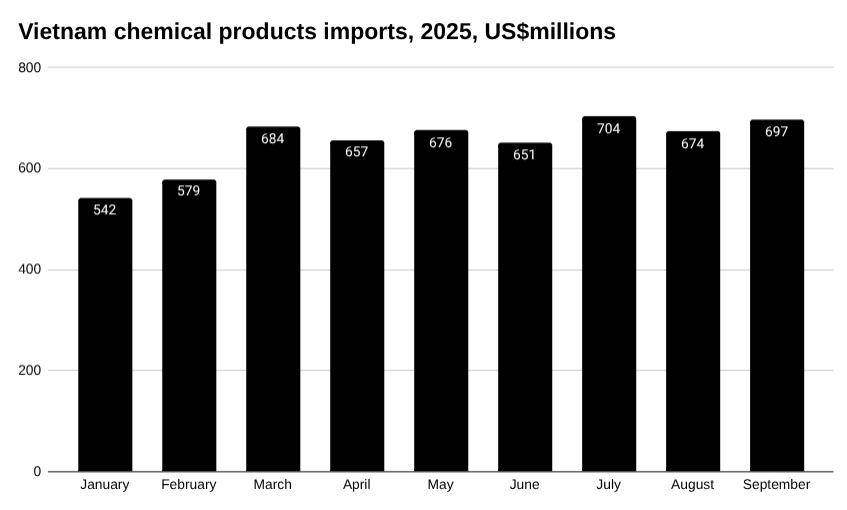
Vietnam’s chemical imports reached US$696.96 million in September 2025, up 3.44 percent month-on-month, according to preliminary data from Vietnam’s General Department of Customs.
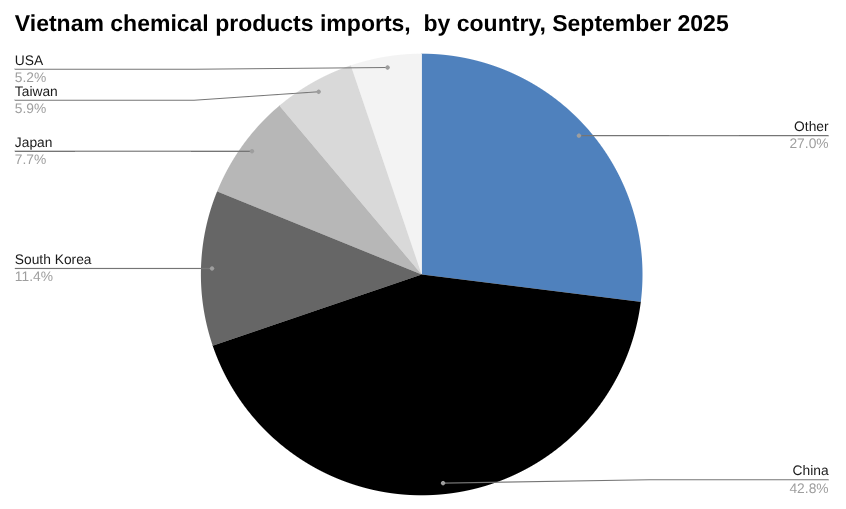
Imports from China rose 4.16 percent to US$298.25 million, maintaining the country’s dominant share in Vietnam’s chemical supply chain.
South Korea followed with US$79.22 million, up 10.16 percent, while Japan recorded a modest 3.72 percent increase to US$53.78 million.
Taiwan, Thailand, and Malaysia saw declines in shipments, down 10.23, 1.29, and 12.01 percent respectively.
The United States remained a stable supplier at US$36.24 million, up 0.58 percent month-on-month.
Year-to-date, Vietnam imported nearly US$5.88 billion worth of chemical products, reflecting continued demand from manufacturing and industrial sectors.
Germany, Italy, and the United Kingdom saw strong monthly growth of 9.44, 70.21, and 25.34 percent, respectively.
Learn more about finding buyers in Vietnam→
Vietnam chemical products imports, September 2025, US$millions
| September | August | MoM | YTD | |
| Total | 696.96 | 673.76 | 3.44% | 5,879.71 |
| Other | 75.24 | 66.52 | 13.12% | 616.36 |
| China | 298.25 | 286.33 | 4.16% | 2,451.34 |
| South Korea | 79.22 | 71.91 | 10.16% | 658.31 |
| Japan | 53.78 | 51.85 | 3.72% | 480.30 |
| Taiwan | 41.43 | 46.15 | -10.23% | 372.90 |
| USA | 36.24 | 36.04 | 0.58% | 322.59 |
| Thailand | 33.16 | 33.60 | -1.29% | 278.68 |
| Germany | 25.35 | 23.16 | 9.44% | 200.48 |
| Malaysia | 22.20 | 25.23 | -12.01% | 194.67 |
| Indonesia | 18.50 | 17.98 | 2.87% | 156.72 |
| Singapore | 13.58 | 14.99 | -9.41% | 147.38 |
| India | 12.15 | 14.03 | -13.39% | 130.57 |
| Italy | 8.05 | 4.73 | 70.21% | 61.85 |
| France | 6.10 | 5.58 | 9.33% | 50.27 |
| UK | 5.27 | 4.21 | 25.34% | 37.76 |
| Spain | 4.59 | 5.69 | -19.37% | 48.12 |
| Ireland | 3.23 | 1.15 | 181.33% | 16.67 |
| Netherlands | 3.00 | 3.11 | -3.47% | 30.37 |
| Denmark | 2.20 | 5.86 | -62.45% | 22.13 |
| Canada | 1.72 | 2.11 | -18.56% | 12.66 |
| Australia | 1.70 | 2.29 | -25.99% | 19.91 |
| Finland | 1.67 | 0.58 | 187.87% | 12.97 |
| Switzerland | 1.63 | 1.87 | -12.77% | 18.98 |
| Poland | 1.58 | 1.57 | 0.33% | 13.72 |
| Belgium | 1.35 | 1.00 | 35.05% | 13.24 |
| Sweden | 1.34 | 0.99 | 35.33% | 11.10 |
| Turkey | 1.30 | 1.03 | 26.59% | 10.24 |
| Hong Kong | 0.62 | 0.41 | 51.35% | 4.00 |
| Philippines | 0.30 | 0.49 | -38.49% | 4.86 |
| Lithuania | 0.26 | 0.21 | 23.92% | 1.39 |
| Norway | 0.22 | 0.39 | -44.42% | 3.45 |
| Russia | 0.18 | 0.19 | -6.25% | 1.98 |
| New Zealand | 0.17 | 0.70 | -76.03% | 6.34 |
| South Africa | 0.14 | 0.43 | -66.76% | 3.05 |
| Qatar | 0.04 | 0.19 | -78.55% | 1.85 |
| Saudi Arabia | 0.03 | 0.09 | -61.44% | 0.46 |
Listed chemicals companies
PetroVietnam Ca Mau Fertilizer and Chemicals Corp.
PetroVietnam Ca Mau Fertilizer and Chemicals Corp. (DPM) integrates petrochemical and fertilizer operations, producing chemical inputs that support domestic farming as well as chemical processing industries.
DPM closed at VND 23,700 on Tuesday up 0.1 percent with 32,309,000 shares traded, worth VND 75,925 million.
Foreign ownership in DPM is currently capped at 50.0 percent, with current foreign ownership sitting at 5.3 percent.
Duc Giang Chemicals Group
Duc Giang Chemicals Group (DGC) is an industrial chemicals manufacturer, producing a range of products.
DGC closed at VND 94,000 on Tuesday up 1.1 percent with 16,069,000 shares traded, worth VND 150,873 million.
Foreign ownership in DGC is currently capped at 49.0 percent, with current foreign ownership sitting at 11.9 percent.
Learn more about trading on Vietnam’s strong exchange→
Vietnam’s chemicals industry
Vietnam’s chemicals industry plays a vital role in the country’s manufacturing base, supplying inputs for textiles, plastics, electronics, agriculture, and consumer goods.
The sector includes both state-owned and private enterprises, with major listed firms such as Duc Giang Chemicals (DGC), PetroVietnam Fertilizer and Chemicals (DPM), and Lam Thao Fertilizers and Chemicals (LAS).
Vietnam relies heavily on imported raw materials, particularly from China, South Korea, and Japan, while domestic producers focus on downstream processing, basic chemicals, and fertilizers.
As industrialisation accelerates, government policy aims to promote cleaner production, localisation of raw materials, and higher value-added chemical manufacturing.