
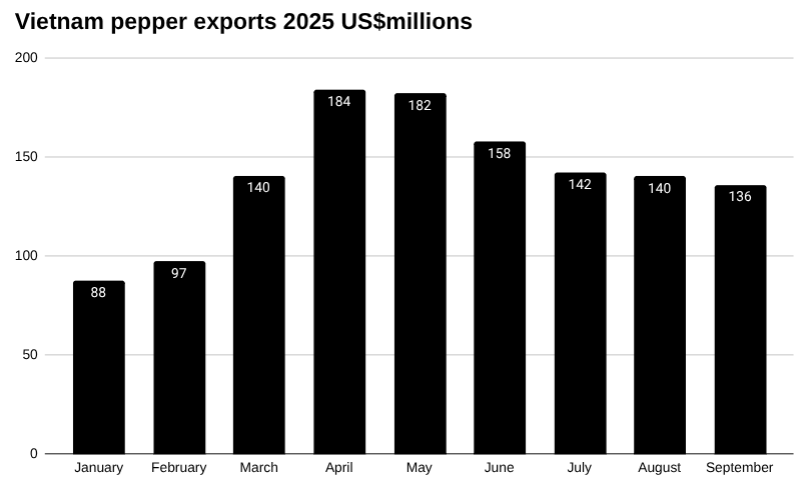
Vietnam’s pepper exports reached US$135.99 million in September 2025, down 3.06 percent from August, according to preliminary data from Vietnam’s General Department of Customs.
Year-to-date exports totalled US$1.27 billion, led by strong demand from the United States, Germany, and the Netherlands.
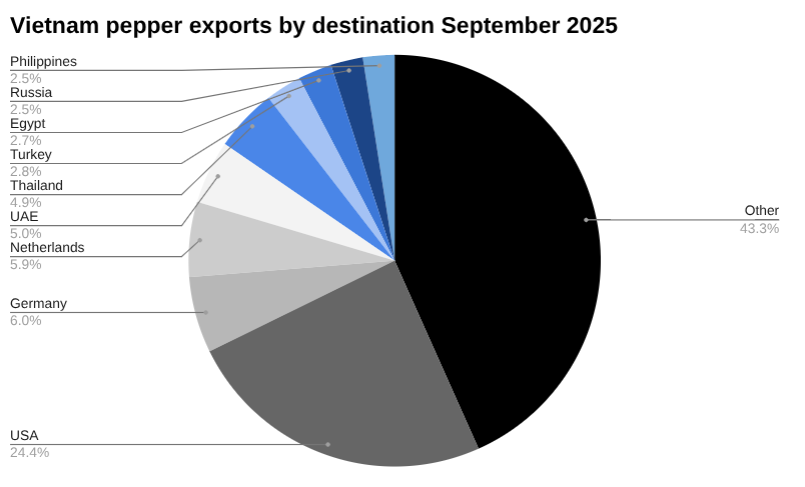
Exports to the United States rose 7.31 percent month-on-month to US$33.20 million.
Germany imported US$8.14 million, down 12.47 percent.
Shipments to the Netherlands dipped slightly by 1.27 percent to US$8.01 million, while exports to the UAE and Thailand rose 12.58 percent and 9.23 percent respectively.
Turkey recorded the strongest growth, with shipments surging 105.10 percent to US$3.84 million.
Meanwhile, exports to Pakistan fell 48.43 percent, Japan dropped 41.74 percent, and Australia declined 43.43 percent.
Learn more about accessing Vietnam’s consumer market→
Vietnam exports of pepper in September 2025, US$millions
| September | August | Change | Year to Date | |
| Total | 135.99 | 140.29 | -3.06% | 1,265.83 |
| Other | 56.02 | 61.24 | -8.53% | 542.05 |
| USA | 33.20 | 30.94 | 7.31% | 312.36 |
| Germany | 8.14 | 9.30 | -12.47% | 99.49 |
| Netherlands | 8.01 | 8.11 | -1.27% | 52.54 |
| UAE | 6.76 | 6.01 | 12.58% | 53.86 |
| Thailand | 6.71 | 6.14 | 9.23% | 42.62 |
| Turkey | 3.84 | 1.87 | 105.10% | 22.63 |
| Egypt | 3.61 | 4.24 | -14.70% | 32.98 |
| Russia | 3.43 | 3.88 | -11.39% | 32.98 |
| Philippines | 3.37 | 3.91 | -13.84% | 30.56 |
| UK | 2.90 | 4.65 | -37.65% | 43.77 |
| South Korea | 2.62 | 3.75 | -30.03% | 39.51 |
| India | 2.57 | 2.93 | -12.44% | 71.01 |
| Canada | 2.36 | 2.79 | -15.46% | 21.74 |
| Saudi Arabia | 2.11 | 3.26 | -35.18% | 20.59 |
| South Africa | 2.03 | 1.04 | 95.15% | 11.25 |
| France | 1.79 | 1.08 | 66.03% | 12.31 |
| Japan | 1.67 | 2.86 | -41.74% | 19.97 |
| Pakistan | 1.60 | 3.11 | -48.43% | 27.00 |
| Italy | 1.49 | 0.22 | 581.63% | 6.61 |
| Australia | 1.30 | 2.30 | -43.43% | 10.78 |
| Spain | 1.18 | 1.65 | -28.88% | 17.25 |
| Malaysia | 1.09 | 1.64 | -33.80% | 13.05 |
| Belgium | 0.70 | 0.60 | 18.40% | 7.50 |
| Algeria | 0.50 | 0.56 | -10.21% | 3.67 |
| Poland | 0.49 | 0.87 | -43.37% | 9.58 |
| Kazakhstan | 0.36 | 0.30 | 20.49% | 3.04 |
| Ukraine | 0.35 | 0.10 | 241.71% | 2.95 |
| Singapore | 0.33 | 0.31 | 4.96% | 3.89 |
| Kuwait | 0.31 | 0.06 | 407.24% | 2.71 |
| Senegal | 0.08 | 0.80 | -90.36% | 14.26 |
Listed agriculture companies
Vietnam National Seed Group
Vietnam National Seed Group JSC (ticker NSC) is a Vietnam-based agribusiness company that researches, produces and sells crop seeds (including rice, corn and vegetables), organic farm products and agricultural services.
NSC closed at VND 79,000 on Tuesday down 0 percent with 33,000 shares traded, worth VND 261 million.
Foreign ownership in NSC is currently capped at 49.0 percent, with current foreign ownership sitting at 9.4 percent.
BAF Vietnam Agriculture Joint Stock Company
BAF Vietnam Agriculture Joint Stock Company (HOSE: BAF) engages in animal husbandry and feed production, including bran and feeds for pigs, alongside processing and pork-meat production.
BAF closed at VND 32,250 on Tuesday up 0.25 percent with 11,268,000 shares traded, worth VND 35,904 million.
Foreign ownership in BAF is currently capped at 50.0 percent, with current foreign ownership sitting at 3.0 percent.
Binh Dien Fertilizer JSC
Binh Dien Fertilizer JSC (BFC) manufactures and trades fertilizers and related agricultural inputs.
BFC closed at VND 43,950 on Tuesday down 0.05 percent with 3,631,000 shares traded, worth VND 15,617 million.
Foreign ownership in BFC is currently capped at 50.0 percent, with current foreign ownership sitting at 1.6 percent.
Explore opening a trading account in Vietnam→
Vietnam’s pepper industry
Vietnam is the world’s largest producer and exporter of pepper, accounting for roughly one-third of global supply.
The industry is concentrated in provinces such as Dak Lak, Dak Nong, Gia Lai, and Ba Ria–Vung Tau, where smallholder farmers dominate production.
Exports are primarily in black and white pepper, with key markets including the United States, EU, India, and the Middle East.
In recent years, fluctuating global prices, rising input costs, and quality control requirements have pressured margins.