
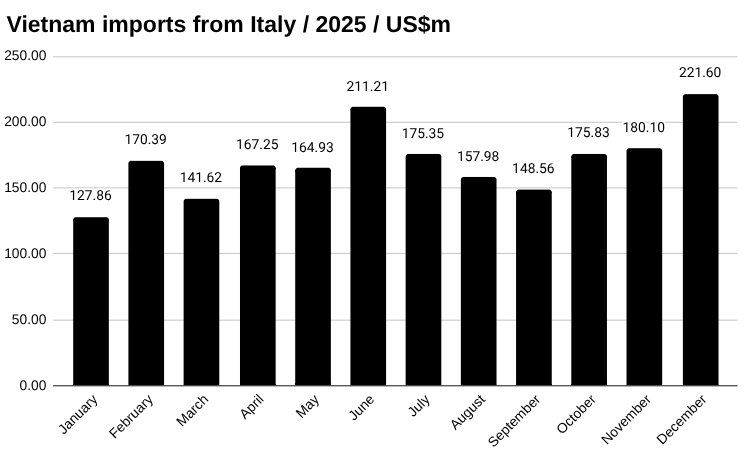
In December, Vietnam imported US$221.60 million worth of goods from Italy, up from US$180.10 million in November, a change of 23.04 percent, according to preliminary data from Vietnam’s General Department of Customs.
So far this year, Vietnam has imported US$2,045 million worth of goods from Italy.
Vietnam imported US$65.87 million worth of machines, equipment, tools and instruments from Italy in December. This was up from US$41.93 million in November, a change of 57.11 percent.
Vietnam imported US$25.03 million worth of pharmaceutical products from Italy in December. This was down from US$31.36 million in November, a change of -20.18 percent.
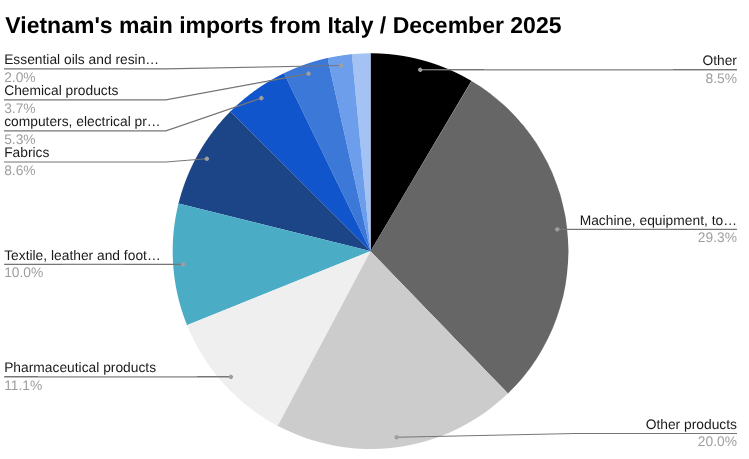
Vietnam imported US$22.43 million worth of textile, leather and footwear materials and auxiliaries from Italy in December. This was up from US$17.62 million in November, a change of 27.31 percent.
Vietnam imported US$19.38 million worth of fabrics from Italy in December. This was up from US$12.46 million in November, a change of 55.54 percent.
Learn more about manufacturing in Vietnam→
Vietnam imports from Italy in December US$m
| December | November | MoM | YTD | |
| Total | 221.60 | 180.10 | 23.04% | 2,044.88 |
| Machine, equipment, tools and instruments | 65.87 | 41.93 | 57.11% | 509.03 |
| Other products | 44.96 | 46.49 | -3.30% | 484.05 |
| Pharmaceutical products | 25.03 | 31.36 | -20.18% | 307.27 |
| Textile, leather and footwear materials and auxiliaries | 22.43 | 17.62 | 27.31% | 236.72 |
| Fabrics | 19.38 | 12.46 | 55.54% | 153.17 |
| computers, electrical products, spare-parts and components thereof | 11.94 | 7.36 | 62.12% | 40.72 |
| Chemical products | 8.37 | 5.93 | 41.22% | 81.82 |
| Essential oils and resinoids; perfumery, cosmetic or toilet preparations | 4.47 | 3.08 | 44.97% | 32.88 |
| Plastic products | 3.38 | 2.42 | 39.67% | 36.17 |
| Iron and steel products | 3.28 | 2.09 | 56.55% | 41.10 |
| Chemicals | 2.99 | 1.32 | 125.77% | 24.16 |
| Wood and wooden products | 1.96 | 1.11 | 76.78% | 19.20 |
| Animal fodders and animal fodder materials | 1.42 | 0.85 | 67.54% | 9.35 |
| Electric consumer products and parts thereof | 1.32 | 1.16 | 13.95% | 8.99 |
| Plastics | 1.32 | 1.12 | 17.17% | 15.21 |
| Rubber products | 1.03 | 1.08 | -3.75% | 14.88 |
| Paper | 0.74 | 0.42 | 76.27% | 7.83 |
| Other base metals | 0.64 | 0.86 | -25.75% | 7.54 |
| Parts and accessories of motor vehicles | 0.57 | 0.68 | -15.43% | 5.54 |
| Pharmaceutical materials | 0.44 | 0.34 | 30.97% | 5.84 |
| Iron and steel | 0.06 | 0.43 | -86.57% | 2.91 |
| Tobacco materials | 0.00 | 0.00 | 0.00% | 0.49 |
Vietnam exports to Italy
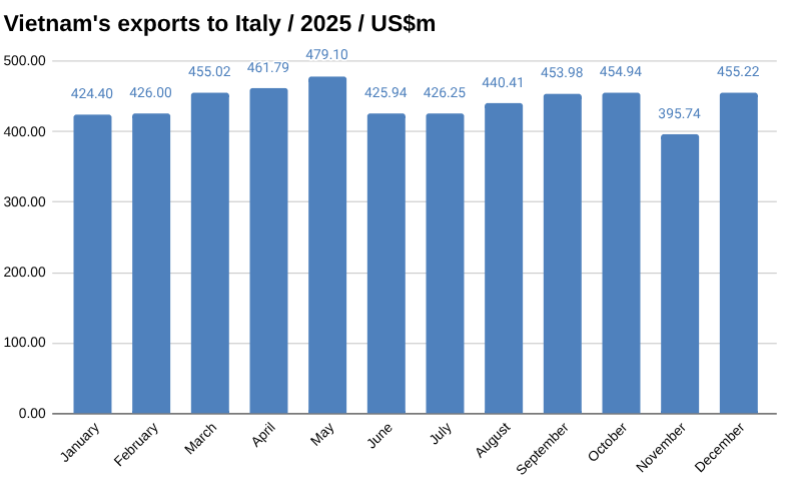
In December, Vietnam exported US$455 million worth of goods to Italy, up 15.03 percent over November, according to preliminary data from Vietnam’s General Department of Customs.
So far this year, Vietnam has exported US$5,298 million worth of goods to Italy.
Vietnam trade with Italy
In December, Vietnam imported US$221.60 million worth of goods from Italy and exported US$455.22 million to Italy, for total trade worth US$676.82 million, and leaving a trade surplus of US$233.62 million.
Two-way trade so far this year between Vietnam and Italy has reached US$7,343 million, with Vietnam importing US$2,045 million worth of goods and exporting US$5,298 million worth of goods.
Discover more about trade in Vietnam→
Vietnam trade with Italy year to date December US$m
| December | November | Change | YTD | |
| Imports | 221.60 | 180.10 | 23.04% | 2,044.88 |
| Exports | 455.22 | 395.74 | 15.03% | 5,298.46 |
| Total | 676.82 | 575.85 | 17.53% | 7,343.34 |
| Balance | 233.62 | 215.64 | 8.34% | 3,253.58 |
Vietnam-Italy trade relations
Vietnam and Italy established diplomatic relations in 1973, with economic ties expanding steadily alongside Vietnam’s market reforms and integration into global trade.
Trade relations are anchored by the European Union–Vietnam Free Trade Agreement, which entered into force in 2020 and progressively reduces tariffs, supports investment protection, and sets rules on standards and procurement.
Italy is a major European trading partner for Vietnam, importing garments, footwear, furniture, and agricultural products, while exporting machinery, industrial equipment, chemicals, and high-end consumer goods.
Bilateral cooperation also includes investment promotion, technology transfer, and sectoral partnerships, supported by business councils, trade missions, and agreements on economic and technical cooperation.