
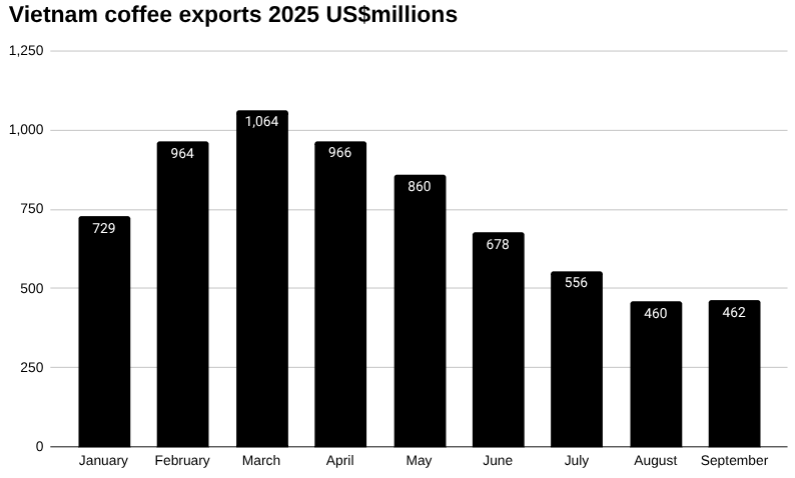
Vietnam’s coffee exports in September 2025 reached US$462.28 million, up 0.5 percent from August, according to preliminary data from Vietnam’s General Department of Customs.
This modest increase brought year-to-date exports to US$7.01 billion, reflecting continued strong demand from major markets despite fluctuations in key destinations.
Italy overtook Germany as Vietnam’s largest coffee buyer in September, importing US$56.18 million, up 40.05 percent month-on-month.
Germany followed with US$38.86 million, rising 26.92 percent, while Algeria recorded a sharp 85.26 percent surge to US$32.75 million.
The United States also posted strong growth of 81.7 percent to US$28.11 million, and Belgium more than doubled its imports to US$17.92 million.
In contrast, exports to Spain, China, and the Netherlands fell 29.84, 33.61, and 27.88 percent respectively.
Among regional markets, Thailand rose 12.63 percent to US$31.71 million and Malaysia climbed 34.58 percent to US$16.28 million.
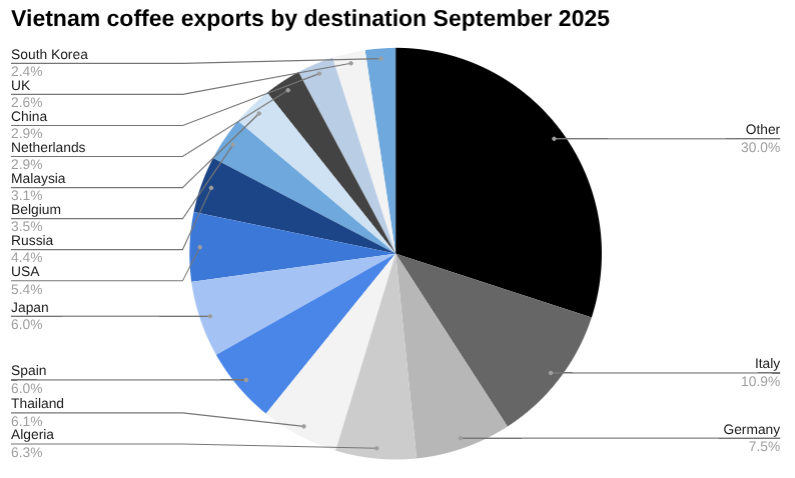
Overall, Europe remained the dominant buyer group, with Italy, Germany, and Spain together accounting for nearly a third of total export value.
Learn more about sourcing coffee from Vietnam→
Recent industry developments
These are some of the most recent developments in Vietnam’s coffee industry.
Nestlé to invest additional US$73 million in southern Vietnam coffee plant
Nestlé Vietnam announced in April that it would invest an additional investment of nearly VND1.9 trillion (US$73.4 million) into its Tri An coffee factory in Dong Nai province, boosting its total investment in the country to nearly VND20.2 trillion (US$780.83 million).
Nestlé Vietnam CEO Binu Jacob said the expansion reflects the company’s confidence in Vietnam’s development potential and its long-term commitment to supporting the country’s growth.
South Korea’s The Venti coffee chain opened its first Vietnam store
South Korean coffee chain The Venti officially entered Vietnam in July, opening its first store in Ho Chi Minh City as part of a broader push to expand across Southeast Asia.
Special menu items include a purple condensed milk latte and Korean-style drinks like Job’s tears oat latte.
Listed coffee companies
Vinacafé Bien Hoa JSC is a Vietnamese food‐processing company founded in 1968 and headquartered in Biên Hòa.
Its core business includes manufacturing and selling coffee products (both roasted and instant).
VCF closed at VND 289,500 on Monday down 0 percent with 14,000 shares traded, worth VND 397 million.
Foreign ownership in VCF is currently capped at 49.0 percent, with current foreign ownership sitting at 0.5 percent.
Vietnam coffee brands
Vietnam’s coffee market is led by several strong domestic brands that have built both local loyalty and export recognition.
G7 by Trung Nguyen Legend is known globally for its bold flavour and wide availability, while Vinacafé remains a pioneer of the country’s instant coffee industry.
Highlands Coffee has become one of Vietnam’s most recognisable café chains, also producing instant and packaged blends for retail.
King Coffee, founded by Le Hoang Diep Thao, focuses on premium markets and international expansion.
Together, these brands represent the evolution of Vietnam’s coffee sector from mass production to global branding and diversification.
Learn more about Vietnam coffee brands →
Instant coffee in Vietnam
Vietnam’s instant coffee sector has become a major part of its broader coffee industry, built on the country’s strong base in robusta production.
Brands like Trung Nguyen’s G7 and Vinacafé dominate the domestic market and export to many countries, especially across Asia, where convenient “3-in-1” sachets are widely consumed.
Growth is now focused on higher quality and value-added products rather than volume, as competition intensifies and consumers shift toward premium and sustainable options.
Producers are investing in modern technology and traceability systems to maintain Vietnam’s position as a leading instant coffee supplier globally.
Vietnam’s coffee industry
Vietnam is one of the world’s largest coffee producers and exporters, with its industry centred in the Central Highlands provinces of Dak Lak, Lam Dong and Gia Lai.
The country mainly produces robusta beans, which account for about 95 percent of total output, and has built a strong presence in global markets such as Europe, the United States and Japan.
In recent years, Vietnam’s coffee industry has focused on improving quality, sustainability and value addition through certified farming practices, modern processing facilities and product diversification.
Rising global prices and strong export demand continue to support growth, though climate risks and replanting needs remain key challenges for long-term stability.