
Vietnam’s coal imports reached US$457.27 million in September 2025, up 21.35 percent from August, according to preliminary data from Vietnam’s General Department of Customs.
This brought total coal import value for the first nine months of the year to US$5.17 billion, reflecting continued high demand from the power and industrial sectors.

Australia remained Vietnam’s largest supplier, with imports more than doubling to US$220.32 million, up 103.03 percent month-on-month.
Indonesia followed with US$154.52 million, an 11 percent increase, while Russia supplied US$58.43 million, down 12.08 percent.
Imports from China and Laos declined by 6.05 percent and 67.35 percent respectively, indicating weaker flows from neighbouring markets.
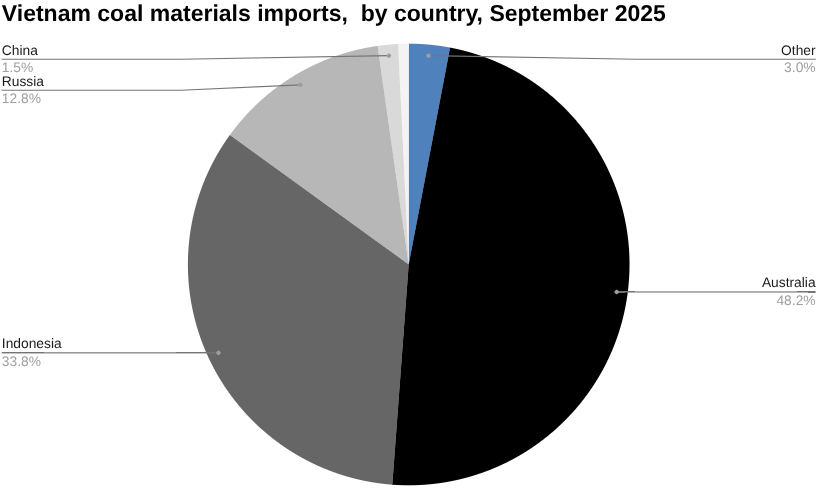
Smaller suppliers such as Japan and Malaysia recorded negligible or zero shipments during the month.
Vietnam’s coal imports continue to rise as domestic output struggles to meet energy demand, particularly during the high-consumption period of late 2025.
Learn more about electricity in Vietnam →
Coal production
Vietnam’s coal production rose 15.32 percent month-on-month to 3,417 thousand tonnes in September 2025.
Year-on-year, output increased sharply by 62.67 percent, while cumulative production for the first nine months of 2025 reached 34,392 million tonnes, up 5.83 percent from the same period last year.
Learn more about the coal in Vietnam→
Coal industry in Vietnam
Vietnam’s coal industry plays a crucial role in the country’s energy mix, supplying fuel for more than one-third of national electricity generation.
Major mining operations are concentrated in Quang Ninh Province under the Vietnam National Coal and Mineral Industries Group (Vinacomin), which oversees both extraction and domestic distribution.
Despite efforts to expand renewables, coal remains vital to energy security as demand rises from industry and urbanisation.
However, the sector faces mounting pressure to modernise, improve safety standards, and reduce emissions in line with Vietnam’s commitments to net-zero by 2050.
Balancing energy needs with environmental goals is now a defining challenge for the industry’s future.
See also: Can Vietnam Ever Quit Coal?