
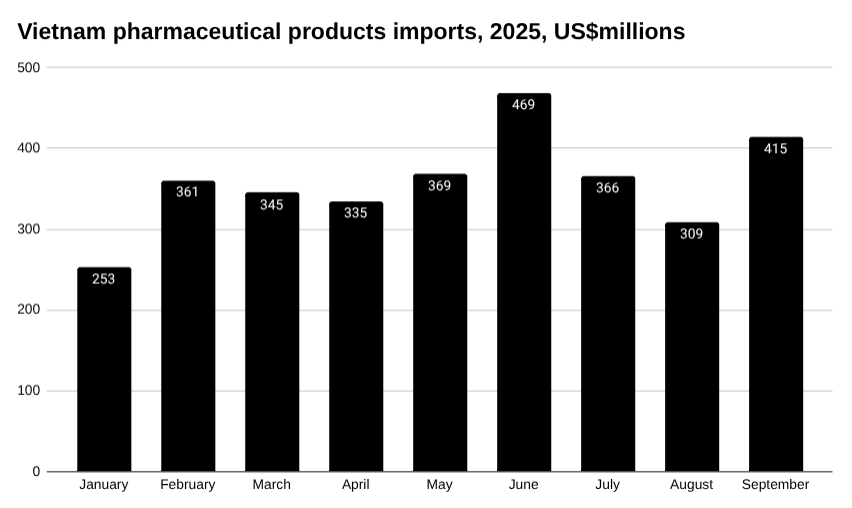
Vietnam’s pharmaceutical imports rose 34.34 percent month-on-month to US$414.51 million in September, according to preliminary data from Vietnam’s General Department of Customs.
Year-to-date imports reached US$3.21 billion, led by strong growth from the United States, France, and Germany.
The US surged 143 percent month-on-month, becoming a key supplier alongside France and Belgium.
Sweden and Denmark also recorded significant gains, up 182 percent and 469 percent respectively.
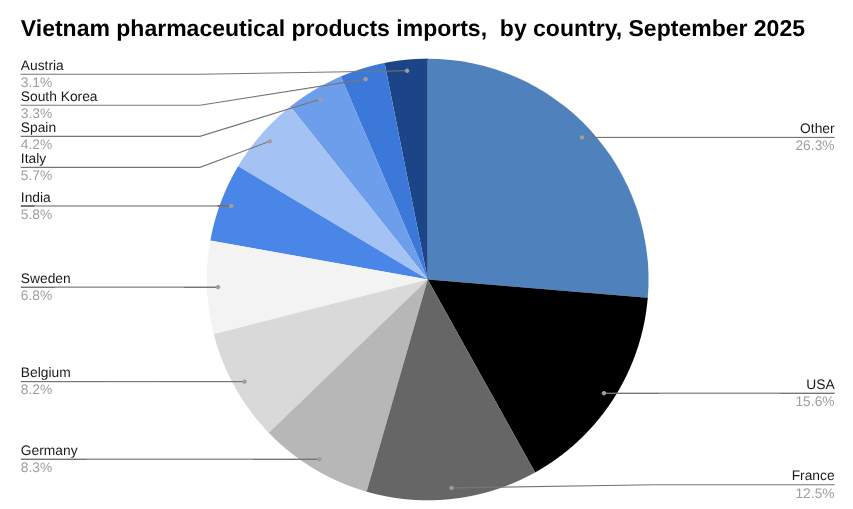
India, traditionally a major source, saw imports fall 8.79 percent, while Japan dropped 26.89 percent.
Learn more about approaching Vietnamese buyers→
Vietnam pharmaceutical products imports, September 2025, US$millions
| September | August | MoM | YTD | |
| Total | 414.51 | 308.56 | 34.34% | 3,212.56 |
| Other | 109.10 | 96.61 | 12.93% | 1,059.70 |
| USA | 64.65 | 26.56 | 143.40% | 374.92 |
| France | 51.99 | 49.12 | 5.84% | 377.12 |
| Germany | 34.52 | 24.68 | 39.90% | 313.23 |
| Belgium | 34.11 | 25.14 | 35.68% | 232.57 |
| Sweden | 28.19 | 10.01 | 181.71% | 135.22 |
| India | 23.84 | 26.14 | -8.79% | 222.19 |
| Italy | 23.81 | 19.54 | 21.87% | 227.33 |
| Spain | 17.61 | 10.01 | 75.86% | 93.69 |
| South Korea | 13.70 | 12.52 | 9.40% | 98.28 |
| Austria | 12.97 | 8.22 | 57.86% | 78.31 |
| Switzerland | 10.29 | 7.35 | 39.98% | 96.25 |
| Ireland | 8.41 | 7.33 | 14.77% | 154.33 |
| UK | 8.37 | 5.18 | 61.48% | 64.30 |
| Netherlands | 6.94 | 10.53 | -34.09% | 73.36 |
| Russia | 6.44 | 3.33 | 93.27% | 38.21 |
| China | 5.85 | 4.49 | 30.43% | 42.50 |
| Denmark | 5.64 | 0.99 | 468.75% | 22.79 |
| Thailand | 4.63 | 4.53 | 2.19% | 53.80 |
| Japan | 3.49 | 4.77 | -26.89% | 44.32 |
| Australia | 2.91 | 2.39 | 22.12% | 39.04 |
| Poland | 2.77 | 3.69 | -24.77% | 35.37 |
| Singapore | 1.88 | 1.29 | 45.13% | 12.18 |
| Turkey | 1.70 | 2.93 | -42.14% | 18.44 |
| Taiwan | 1.62 | 1.27 | 26.82% | 18.81 |
| Cyprus | 1.30 | 0.61 | 114.86% | 18.45 |
| Hungary | 1.27 | 4.04 | -68.61% | 31.57 |
| Malaysia | 1.26 | 1.57 | -19.81% | 6.45 |
| Indonesia | 1.14 | 2.27 | -49.85% | 12.49 |
| Canada | 1.04 | 0.29 | 265.39% | 13.08 |
| Bangladesh | 0.85 | 0.65 | 31.36% | 7.58 |
| Argentina | 0.83 | 0.08 | 893.27% | 5.08 |
| Lithuania | 0.45 | 0.97 | -53.82% | 3.12 |
| Pakistan | 0.40 | 0.57 | -28.56% | 6.33 |
| Philippines | 0.15 | 0.06 | 158.27% | 0.39 |
Listed pharmaceutical companies
DHG Pharmaceutical Joint Stock Company
DHG Pharmaceutical Joint Stock Company (DHG) manufactures and markets a wide range of pharmaceutical products, health supplements and cosmetics.
DHG closed at VND 108,000 on Wednesday down 0.1 percent with 543,000 shares traded, worth VND 5,874 million.
Foreign ownership in DHG is currently capped at 100.0 percent, with current foreign ownership sitting at 53.9 percent.
Imexpharm Corporation
Imexpharm Corporation (IMP) operates multiple EU-GMP certified factory clusters and engaged in the manufacture, import/export and trade of pharmaceutical products.
IMP closed at VND 48,800 on Wednesday down 0.15 percent with 312,000 shares traded, worth VND 1,525 million.
Foreign ownership in IMP is currently capped at 78.0 percent, with current foreign ownership sitting at 51.4 percent.
Traphaco Joint Stock Company
Traphaco Joint Stock Company (TRA) is engaged in the production and trading of pharmaceuticals, chemicals, functional foods, cosmetics and medical equipment.
TRA closed at VND 66,500 on Wednesday down 0.2 percent with 17,000 shares traded, worth VND 113 million.
Foreign ownership in TRA is currently capped at 49.0 percent, with current foreign ownership sitting at 46.3 percent.
Explore opening a trading account in Vietnam→
Vietnam’s pharmaceuticals industry
Vietnam’s pharmaceuticals market is expanding, supported by an ageing population, growing healthcare spending, and broader insurance coverage.
Domestic pharmaceuticals manufacturing focuses mainly on generic drugs, but Vietnam still relies heavily on imports, which account for a significant amount of total medicine consumption.
Many local facilities have yet to meet advanced GMP standards, and the distribution network remains fragmented, with numerous small pharmacies and multilayered supply chains adding complexity and cost.
The sector presents strong growth potential but requires foreign investors to navigate evolving regulations, form partnerships with local firms in many cases, and prioritise higher-value segments such as biologics and modern manufacturing.