
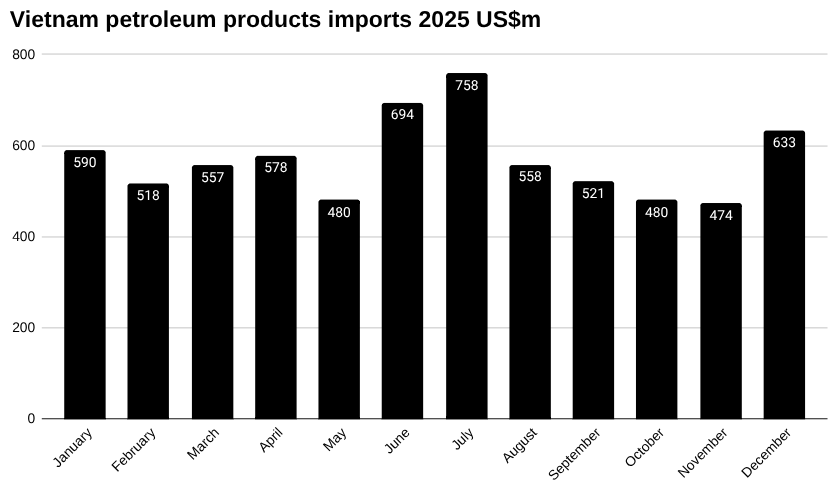
Vietnam imported petroleum products to the tune of US$633 million in December, up from US$474 million in November, a change of 33.76 percent, according to preliminary data from Vietnam’s General Department of Customs.
Year to date, Vietnam had imported US$6,820 million worth of petroleum products by the end of December.
Singapore accounted for US$214 million worth of Vietnam’s petroleum products imports in December. This was up from US$112 million in petroleum products imports in November, a change of 92.07 percent. Year to date, Singapore has shipped US$2,341 million worth of petroleum products to Vietnam.
After Singapore was South Korea making up US$136 million worth of Vietnam’s petroleum products imports in December. This was up from US$130 million in petroleum products imports in November, a change of 4.23 percent. Year to date, South Korea has shipped US$1,829 million worth of petroleum products to Vietnam.
Next was China contributing US$110 million worth of Vietnam’s petroleum products imports in December. This was down from US$118 million in petroleum products imports in November, a change of 6.31 percent. Year to date, China has shipped US$1,016 million worth of petroleum products to Vietnam.
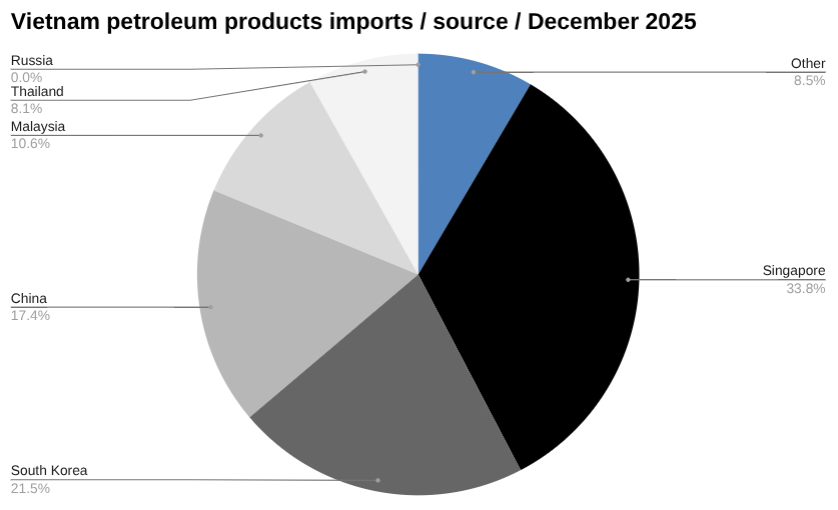
Following China was Malaysia representing US$67 million worth of Vietnam’s petroleum products imports in December. This was up from US$56 million in petroleum products imports in November, a change of 20.63 percent. Year to date, Malaysia has shipped US$1,026 million worth of petroleum products to Vietnam.
Rounding out the top five was Thailand constituting US$52 million worth of Vietnam’s petroleum products imports in December. This was up from US$33 million in petroleum products imports in November, a change of 55.49 percent. Year to date, Thailand has shipped US$311 million worth of petroleum products to Vietnam.
Learn more about accessing Vietnam’s consumer market→
Vietnam imports of petroleum products in December, US$m
| December | November | MoM | YTD | |
| Total | 633.35 | 473.50 | 33.76% | 6,819.94 |
| Other | 53.70 | 24.69 | 117.48% | 296.56 |
| Singapore | 214.38 | 111.61 | 92.07% | 2,341.36 |
| South Korea | 136.02 | 130.50 | 4.23% | 1,829.29 |
| China | 110.30 | 117.73 | -6.31% | 1,015.70 |
| Malaysia | 67.34 | 55.82 | 20.63% | 1,025.95 |
| Thailand | 51.54 | 33.15 | 55.49% | 310.77 |
| Russia | 0.07 | 0.00 | 0.00% | 0.15 |
| Hong Kong | 0.00 | 0.00 | 0.00% | 0.15 |
| Japan | 0.00 | 0.00 | 0.00% | 0.02 |
Listed petroleum products companies
These companies are listed on the Ho Chi Minh City Stock Exchange.
An Pha Petrol Joint Stock Company
An Pha Petrol Joint Stock Company (ASP) trades liquefied gas, petroleum equipment and materials, and transports petroleum products.
ASP closed at VND 4,850 on Friday up 0.05 percent with 327,000 shares traded, worth VND 155 million.
Foreign ownership in ASP is currently capped at 0.0 percent, with current foreign ownership sitting at 0.0 percent.
Binh Son Refining and Petrochemical JSC
Binh Son Refining and Petrochemical JSC (BSR) operates the Dung Quat Refinery and engages in refining crude oil and producing petroleum products.
BSR closed at VND 19,700 on Friday up 1.1 percent with 388,129,000 shares traded, worth VND 764,075 million.
Foreign ownership in BSR is currently capped at 79.1 percent, with current foreign ownership sitting at 1.9 percent.
Petroleum Materials Distribution JSC
Petroleum Materials Distribution JSC (COM) trades petroleum products and distributes fuels and lubricants under the Petrolimex network.
COM closed at VND 29,800 on Friday down 0 percent with 0 shares traded, worth VND 0 million.
Foreign ownership in COM is currently capped at 49.0 percent, with current foreign ownership sitting at 0.2 percent.
Petrolimex International Trading JSC
Petrolimex International Trading JSC (PIT) imports, exports, and trades petroleum, chemicals, and industrial materials.
PIT closed at VND 6,790 on Friday down 0.01 percent with 2,000 shares traded, worth VND 1 million.
Foreign ownership in PIT is currently capped at 0.0 percent, with current foreign ownership sitting at 0.0 percent.
Petrolimex Joint Stock Tanker Company
Petrolimex Joint Stock Tanker Company (PJT) transports petroleum products by sea and provides maritime logistics services.
PJT closed at VND 9,500 on Friday down 0 percent with 0 shares traded, worth VND 0 million.
Foreign ownership in PJT is currently capped at 0.0 percent, with current foreign ownership sitting at 0.0 percent.
Petrolimex Group JSC
Petrolimex Group JSC (PLX) is Vietnam’s largest petroleum distributor, operating fuel retail, storage, and logistics networks nationwide.
PLX closed at VND 43,000 on Friday up 1.5 percent with 81,351,000 shares traded, worth VND 347,170 million.
Foreign ownership in PLX is currently capped at 20.0 percent, with current foreign ownership sitting at 14.8 percent.
PetroVietnam Drilling and Well Services Corporation
PetroVietnam Drilling and Well Services Corporation (PVD) provides oil drilling, engineering, and technical services for the petroleum industry.
PVD closed at VND 29,500 on Friday down 0.9 percent with 77,882,000 shares traded, worth VND 234,445 million.
Foreign ownership in PVD is currently capped at 49.0 percent, with current foreign ownership sitting at 11.0 percent.Explore opening a trading account in Vietnam→
Vietnam petroleum products news
Recent developments include:
Fuel retailer market exit
The Ministry of Industry and Trade has revoked the fuel distribution licence of Dai Long Petroleum Trading Joint Stock Company at the firm’s request, effective January 2026.
The Hanoi based company was granted its fuel distributor licence in July 2023, valid to July 2028, before formally asking to exit the business in December 2025.
Vietnam reportedly now has just over 250 fuel distributors, down from more than 330 two years ago, while total fuel consumption in 2025 was about 26.4 million cubic metres or tonnes, unchanged year on year.
See the latest Vietnam news headlines→
Vietnam’s petroleum products industry
Vietnam’s petroleum products industry plays a central role in the economy by supplying fuels for transport, power generation, manufacturing, and household use.
The sector is closely regulated, with pricing, distribution, and reserves managed to support energy security and macroeconomic stability.
Domestic refining capacity has expanded in recent years, reducing reliance on imports but not eliminating exposure to global oil price movements.
At the retail level, petroleum products remain sensitive to policy adjustments, taxes, and fees, making the industry an important transmission channel between global energy markets and domestic inflation.