
Intel plans to shift more of its assembly, packaging, and testing operations from Costa Rica to Vietnam, VnExpress has reported → view source.
Intel Products Vietnam (IPV) General Director Kenneth Tse reportedly discussed the plan with Ho Chi Minh City Chairman Nguyen Van Duoc on 24 October.
The expansion will require new recruitment through 2025, mainly production technicians.
Intel’s HCMC facility, already its largest assembly and testing site, produces over half of Intel’s global output and employs more than 6,000 workers, the publication says.
Vietnam electronics exports
Vietnam’s exports of computers, electrical products, and spare parts rose 4.31 percent month-on-month in September 2025 to US$10.59 billion, according to the latest date from Vietnam’s General Department of Customs.
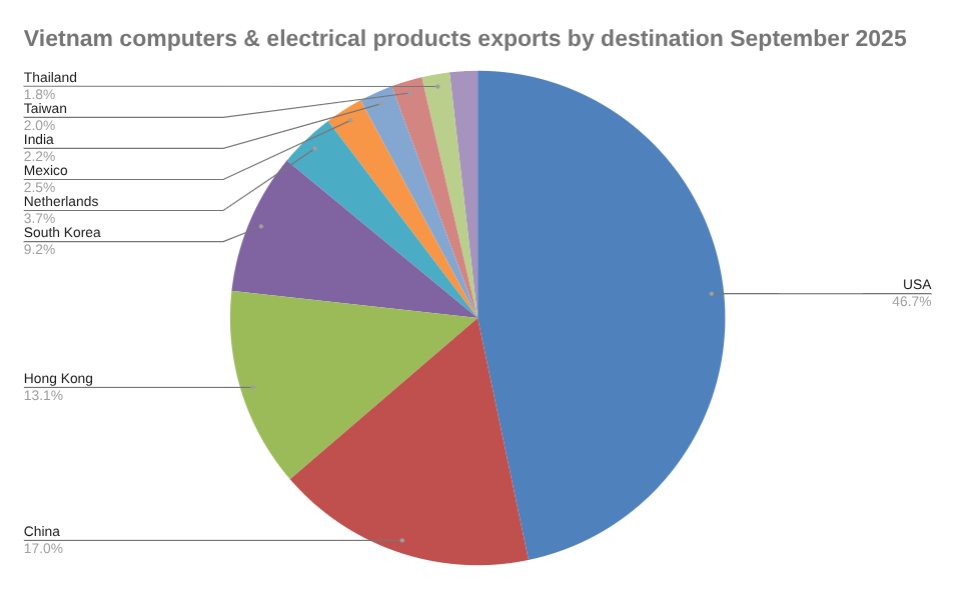
Year-to-date exports reached US$77.49 billion, underscoring the sector’s strong position as one of Vietnam’s top export categories.
Growth was led by the U.S., which imported US$4.18 billion, up 8.26 percent month-on-month.
Learn more about electronics manufacturing in Vietnam→
Vietnam electronics imports
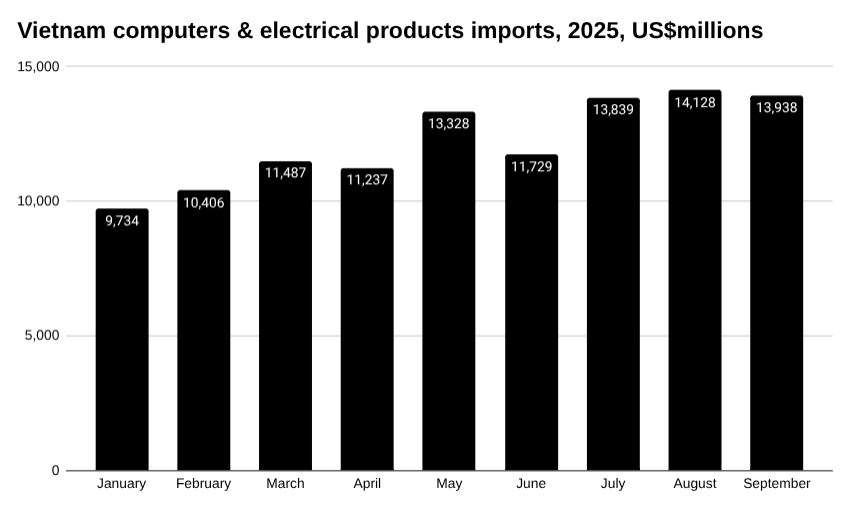
Vietnam’s imports of computers, electrical products, spare parts and components fell by 1.35 percent month-on-month to US$13.94 billion in September, according to Vietnam’s General Department of Customs.
Year-to-date imports totalled US$109.98 billion, maintaining electronics as one of the country’s largest import categories.
China remained Vietnam’s leading supplier at US$4.85 billion, down 0.83 percent from August.
Electronics manufacturing in Vietnam
Vietnam has become one of Asia’s leading electronics manufacturing hubs, attracting major global investors such as Samsung, Intel, and Foxconn.
The country’s advantages include competitive labour costs, trade access through multiple free trade agreements, and a relatively stable business environment.
Electronics now account for a large share of Vietnam’s exports, led by products like smartphones, semiconductors, and computer components.
However, most high-value components are still imported, leaving domestic value-added relatively low.
To move up the global supply chain, Vietnam will need to focus on developing local suppliers, investing in technology and workforce training, and promoting high-tech industrial parks.