
Vietnam’s pig farmers are struggling as live hog prices fall to around VND 50,000 or US$1.90 per kilogram, down from VND 68,000 or US$2.58 last month Dan Tri has reported→ view source.
High feed costs, labour expenses, and the spread of African swine fever (ASF) have made farmers reluctant to restock ahead of Tet 2026. ASF has caused over 2,000 outbreaks and nearly one million pig culls nationwide, cutting the herd to 26.2 million, down 0.6 percent year-on-year.
While large producers in Dong Nai can meet southern demand, smaller farmers lack capital and disease control capacity.
Authorities project year-end consumption to rise 10–15 percent but warn that sustained price pressure and ASF risks could disrupt supply stability, the publication says.
Add your expert opinion to this article: Send a letter to the editor→
AFS & Vietnam’s pork market
Of note, African swine fever (ASF) first appeared in Vietnam in February 2019, spreading nationwide within seven months and cutting the country’s pig herd by over 3 million.
Pork output fell nearly 14 percent, prompting higher imports as local supply collapsed.
Tariff cuts under trade deals such as the CPTPP and EVFTA accelerated the influx of foreign pork, with imports jumping from 81,686 tonnes in 2019 to 256,844 tonnes in 2021.
Although local production later recovered, new ASF outbreaks have revived import demand.
Vietnamese producers now face mounting competition from cheaper, tariff-free pork, while domestic vaccination and biosecurity efforts remain limited and uneven.
Read more about how ASF has impacted Vietnam’s pork industry→
Vietnam’s pork imports
Vietnam’s pork imports rose sharply after the 2019 African swine fever outbreak, peaking at 256,844 tons in 2021 as domestic supply collapsed.
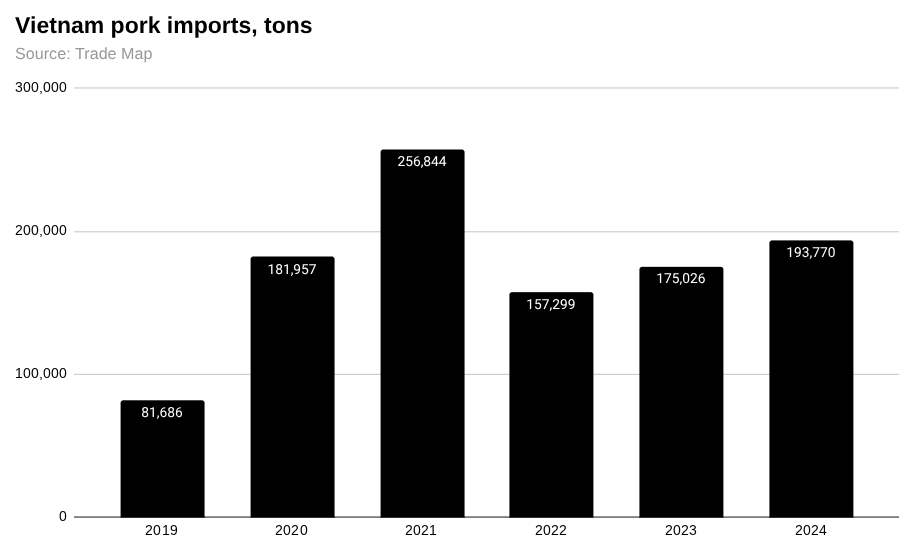
Although volumes dipped in 2022 as herds recovered, imports have climbed again, reaching 193,770 tons in 2024, reflecting ongoing disease risks and strong consumer demand for affordable pork.
Read more about Vietnam’s meat market→
Vietnam pork production
Vietnam’s pork production reached 1.34 million tonnes in the third quarter of 2025, up 2 percent year-on-year, according to data from the National Statistics Office.
This marks a modest increase from the second quarter’s 1.33 million tonnes, reflecting stable herd recovery and stronger domestic demand.
In the first nine months of 2025, total pork output reached 4.04 million tonnes, 4.6 percent higher than the same period last year.
The quarterly pace of growth, however, slowed from 6.4 percent in Q2 to 2 percent in Q3, as feed costs remained high and smallholders faced tighter margins.
Vietnam’s pork industry
Vietnam’s pork industry is the largest segment of its livestock sector, supplying over 60 percent of the country’s meat.
Production is dominated by smallholder farms, though larger integrated companies such as CP Foods Vietnam, Dabaco, Masan Meat Life, and Vissan are expanding their market share.
Industrial-scale farming, improved biosecurity, and feed self-sufficiency are being pursued to stabilise production and strengthen Vietnam’s long-term pork supply chain, however, improvements are taking some time.