
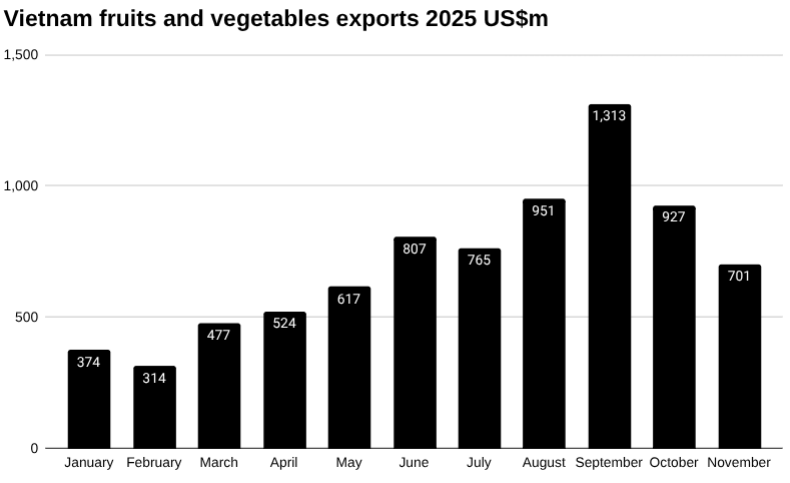
Vietnam exported fruits and vegetables to the tune of US$701 million in November, down from US$927 million in October, a change of -24.39 percent, according to preliminary data from Vietnam’s General Department of Customs.
Year to date, Vietnam had exported US$7,759 million worth of fruits and vegetables by the end of November.
China accounted for US$455 million worth of Vietnam’s fruits and vegetables exports in November. This was down from US$666 million in fruits and vegetables exports in October, a change of -31.64 percent. Year to date, Vietnam has shipped US$4,977 million worth of fruits and vegetables to China.
After China was the USA making up US$45 million worth of Vietnam’s fruits and vegetables exports in November. This was down from US$48 million in fruits and vegetables exports in October, a change of -6.20 percent. Year to date, Vietnam has shipped US$499 million worth of fruits and vegetables to USA.
Next was South Korea taking US$20 million worth of Vietnam’s fruits and vegetables exports in November. This was down from US$27 million in fruits and vegetables exports in October, a change of -25.68 percent. Year to date, Vietnam has shipped US$284 million worth of fruits and vegetables to South Korea.
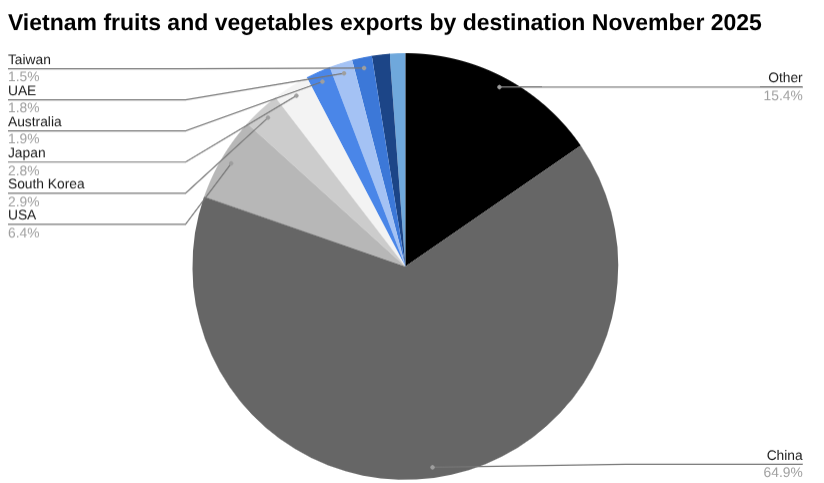
Following South Korea was Japan representing US$20 million worth of Vietnam’s fruits and vegetables exports in November. This was up from US$19 million in fruits and vegetables exports in October, a change of 4.76 percent. Year to date, Vietnam has shipped US$221 million worth of fruits and vegetables to Japan.
Rounding out the top five was Australia constituting US$13 million worth of Vietnam’s fruits and vegetables exports in November. This was down from US$14 million in fruits and vegetables exports in October, a change of -7.75 percent. Year to date, Vietnam has shipped US$128 million worth of fruits and vegetables to Australia.
Learn more about manufacturing in Vietnam→
Vietnam exports of fruits and vegetables in November, US$m
| November | October | MoM | YTD | |
| Total | 701.17 | 927.39 | -24.39% | 7,758.67 |
| Other | 100.81 | 97.59 | 3.30% | 1,039.82 |
| China | 455.02 | 665.64 | -31.64% | 4,977.20 |
| USA | 44.82 | 47.78 | -6.20% | 499.23 |
| South Korea | 20.09 | 27.03 | -25.68% | 284.22 |
| Japan | 19.52 | 18.63 | 4.76% | 220.67 |
| Australia | 13.18 | 14.29 | -7.75% | 127.96 |
| UAE | 12.35 | 12.07 | 2.34% | 109.83 |
| Taiwan | 10.56 | 13.03 | -18.98% | 158.84 |
| Netherlands | 9.37 | 12.35 | -24.13% | 145.08 |
| Malaysia | 8.25 | 11.15 | -26.04% | 90.84 |
| Thailand | 7.21 | 7.83 | -7.95% | 104.97 |
| Germany | 7.15 | 6.77 | 5.68% | 75.06 |
| Canada | 6.64 | 6.78 | -1.98% | 69.41 |
| Russia | 6.46 | 6.17 | 4.68% | 66.38 |
| Cambodia | 4.97 | 5.03 | -1.21% | 34.95 |
| France | 4.89 | 4.27 | 14.47% | 51.59 |
| Singapore | 4.43 | 4.52 | -2.03% | 42.73 |
| Saudi Arabia | 4.23 | 3.73 | 13.46% | 23.17 |
| Hong Kong | 3.97 | 5.86 | -32.33% | 72.08 |
| UK | 3.81 | 5.22 | -27.00% | 51.47 |
| Egypt | 3.48 | 2.07 | 67.87% | 17.69 |
| Indonesia | 2.45 | 0.64 | 281.36% | 11.76 |
| Italy | 2.19 | 3.61 | -39.39% | 37.41 |
| Laos | 0.70 | 0.80 | -12.59% | 9.51 |
| Norway | 0.43 | 0.39 | 12.32% | 3.99 |
| Kuwait | 0.40 | 0.53 | -24.25% | 3.41 |
| Lithuania | 0.33 | 0.71 | -53.53% | 11.46 |
| Switzerland | 0.33 | 0.24 | 34.83% | 2.95 |
| Kazakhstan | 0.32 | 0.03 | 1086.76% | 2.85 |
| Senegal | 0.25 | 0.36 | -30.94% | 5.47 |
| Ukraine | 0.24 | 0.49 | -49.93% | 2.61 |
| Kyrgyzstan | 0.00 | 0.00 | 0.00% | 0.07 |
Listed fruits and vegetables companies
Nafoods Group JSC
Nafoods Group JSC (NAF) produces and exports fruit concentrates, frozen fruits, and agricultural products.
NAF closed at VND 35,900 on Friday down 0.1 percent with 3,605,000 shares traded, worth VND 12,912 million.
Foreign ownership in NAF is currently capped at 122.7 percent, with current foreign ownership sitting at 20.9 percent.
Vietnam National Seed Group
Vietnam National Seed Group (NSC) produces, researches, and distributes crop seeds including rice, corn, and vegetables.
NSC closed at VND 79,100 on Friday up 1.1 percent with 6,000 shares traded, worth VND 47 million.
Foreign ownership in NSC is currently capped at 49.0 percent, with current foreign ownership sitting at 9.6 percent.
Southern Seed Corporation
Southern Seed Corporation (SSC) researches, produces, and trades agricultural seeds such as rice, corn, and vegetables.
SSC closed at VND 31,000 on Friday down 1 percent with 10,000 shares traded, worth VND 31 million.
Foreign ownership in SSC is currently capped at 49.0 percent, with current foreign ownership sitting at 0.8 percent.
Explore opening a trading account in Vietnam→
Vietnam’s fruits and vegetables news
Recent developments in fruits and vegetables in Vietnam include:
China-Vietnam durian codes
China has approved nearly 1,000 additional planting-area codes and packing facilities for Vietnam’s durian industry, following technical talks between Vietnam’s Ministry of Agriculture and Environment and China’s General Administration of Customs.
Vietnam has submitted a technical report explaining cadmium residues in durian and outlining mitigation measures such as biochar use, balanced fertiliser application and intercropping.
Hanoi market stabilisation program
Hanoi has activated its market stabilisation programme ahead of the Lunar New Year to counter recent vegetable price volatility caused by weather-related supply disruptions.
The city is increasing stockpiles, expanding regional supply links, and tightening market inspections to ensure sufficient supply and stable prices during the peak holiday period.
See the latest Vietnam news headlines→
Vietnam’s fruits and vegetables industry
Vietnam’s fruits and vegetables industry is a fast-growing agricultural sector, supported by diverse climates, improving farm productivity, and rising export demand.
The industry supplies both domestic consumption and overseas markets, with key products including mangoes, bananas, dragon fruit, durian, and leafy vegetables.
Exports are expanding across Asia, the United States, and Europe as growers invest in food safety standards, traceability, and post-harvest processing.
Ongoing challenges include logistics costs, quality consistency, and climate risks, but the sector remains a priority for value-added agricultural growth.