
Vietnam’s fresh milk output in September 2025 reached 136 million litres, down 0.83 percent from August, according to preliminary data from Vietnam’s National Statistics Office.
For the first nine months of 2025, production totalled 1.24 billion litres, up 7 percent year-on-year.
September’s output was 95 percent of the same month last year.
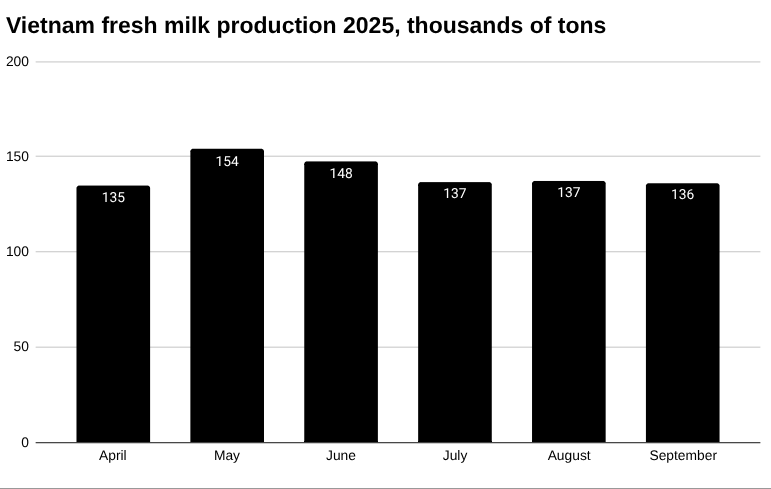
The increase in cumulative output highlights continued expansion in Vietnam’s dairy sector, supported by farm modernisation and growing domestic consumption.
Explore Vietnam’s dairy sector→
Vietnam’s milk imports
Vietnam’s fresh milk industry has grown rapidly over the past decade, driven by rising consumer demand, higher incomes, and improved production capacity.
Major domestic producers such as Vinamilk, Moc Chau Milk, and TH True Milk have expanded large-scale dairy farms using modern technology and imported high-yield cattle breeds.
Government policies promoting self-sufficiency in dairy production have also encouraged investment in cold-chain infrastructure and regional processing hubs.
Despite this progress, Vietnam still relies on imported dairy materials to meet local consumption needs.
Challenges remain in feed costs, productivity gaps, and land availability for expansion.
However, the sector continues to attract both domestic and foreign investors, reflecting strong long-term potential as Vietnam’s per capita milk consumption continues to rise.