
Vietnam’s imports of fishery products reached US$271.69 million in September 2025, down 2.45 percent from August, according to preliminary data from Vietnam’s General Department of Customs.
Total imports in the first nine months stood at US$2.43 billion.

Imports from India dropped 18.96 percent month-on-month to US$39.39 million, while Norway saw a sharp 21.96 percent decline to US$25.27 million.
Shipments from Indonesia rose 4.89 percent to US$37.36 million, and China increased 21.59 percent to US$23.44 million.
The United States recorded a strong gain of 79 percent to US$19.73 million, while Canada and South Korea grew 37.94 percent and 44.94 percent respectively.
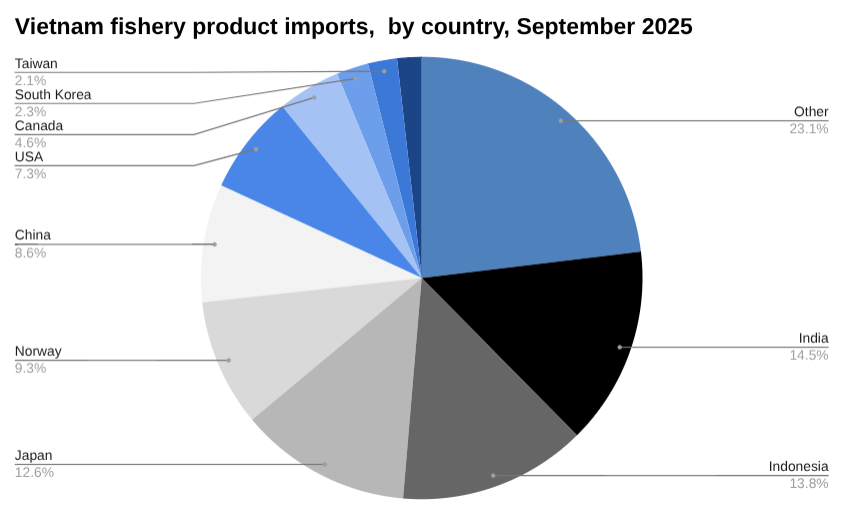
Among smaller suppliers, Thailand rose 31.02 percent to US$2.51 million, and Poland increased 136.11 percent from a low base.
Learn more about accessing Vietnam’s consumer market→
Vietnam imports of fishery products in September 2025, US$millions
| September | August | MoM | YTD | |
| Total | 271.69 | 278.51 | -2.45% | 2,426.74 |
| Other | 62.74 | 67.49 | -7.04% | 631.60 |
| India | 39.39 | 48.61 | -18.96% | 364.50 |
| Indonesia | 37.36 | 35.62 | 4.89% | 344.93 |
| Japan | 34.22 | 35.82 | -4.46% | 224.05 |
| Norway | 25.27 | 32.38 | -21.96% | 260.29 |
| China | 23.44 | 19.28 | 21.59% | 201.31 |
| USA | 19.73 | 11.02 | 79.00% | 79.39 |
| Canada | 12.50 | 9.07 | 37.94% | 46.24 |
| South Korea | 6.38 | 4.40 | 44.94% | 65.31 |
| Taiwan | 5.79 | 8.77 | -34.02% | 103.71 |
| Chile | 4.85 | 6.05 | -19.73% | 105.41 |
| Russia | 4.48 | 5.24 | -14.47% | 77.06 |
| UK | 4.23 | 4.17 | 1.44% | 42.10 |
| Philippines | 3.90 | 3.64 | 7.34% | 34.89 |
| Thailand | 2.51 | 1.92 | 31.02% | 14.56 |
| Malaysia | 1.93 | 2.62 | -26.18% | 16.68 |
| Ireland | 1.83 | 0.00 | 0.00% | 5.00 |
| Iceland | 0.60 | 0.00 | 0.00% | 0.90 |
| Poland | 0.53 | 0.22 | 136.11% | 4.89 |
| Lithuania | 0.36 | 0.76 | -52.97% | 2.71 |
| Myanmar | 0.28 | 0.19 | 43.31% | 1.97 |
| Denmark | 0.24 | 2.19 | -89.20% | 16.68 |
| Bangladesh | 0.13 | 0.00 | 0.00% | 1.28 |
| Singapore | 0.03 | 0.03 | -17.95% | 0.95 |
| Cambodia | 0.00 | 0.00 | 0.00% | 0.06 |
Listed fishery products companies
Mekong Fisheries Joint Stock Company
Mekong Fisheries Joint Stock Company (AAM) processes and exports frozen and fresh fish such as pangasius fillets, octopus, and cuttlefish from its base in the Mekong Delta.
AAM closed at VND 7,000 on Friday down 0.01 percent with 13,000 shares traded, worth VND 9 million.
Foreign ownership in AAM is currently capped at 49.0 percent, with current foreign ownership sitting at 0.8 percent.
Vinh Hoan Corporation
Vinh Hoan Corporation (VHC) is a leading Vietnamese seafood exporter that farms and processes pangasius and other value-added products for global markets.
VHC closed at VND 59,000 on Friday up 1.4 percent with 22,953,000 shares traded, worth VND 135,400 million.
Foreign ownership in VHC is currently capped at 100.0 percent, with current foreign ownership sitting at 19.3 percent.
Cuulong Fish Joint Stock Company
Cuulong Fish Joint Stock Company (ACL) is engaged in farming and processing pangasius fillets, fish sticks and breaded products in An Giang province.
ACL closed at VND 13,350 on Friday down 0 percent with 41,000 shares traded, worth VND 54 million.
Foreign ownership in ACL is currently capped at 39.5 percent, with current foreign ownership sitting at 2.1 percent.
Sao Ta Foods Joint Stock Company
Sao Ta Foods Joint Stock Company (FMC) farms, processes, and exports shrimp and other aquatic products, including breaded and pre-fried items.
FMC closed at VND 36,400 on Friday down 0.05 percent with 438,000 shares traded, worth VND 1,591 million.
Foreign ownership in FMC is currently capped at 50.0 percent, with current foreign ownership sitting at 31.0 percent.
Explore opening a trading account in Vietnam→
Vietnam’s fishery products industry
Vietnam’s fishery products industry is a major export-oriented sector that plays an important role in the national economy.
It encompasses aquaculture, capture fisheries, processing, and export, with the Mekong Delta as the main production hub.
The industry benefits from competitive labour, strong trade links, and expanding processing capacity supported by free trade agreements.
Challenges include sustainability compliance, rising input costs, and environmental pressures such as salinity and climate change.
Vietnam is shifting toward value-added products and market diversification to strengthen competitiveness and reduce reliance on a few key export destinations.