
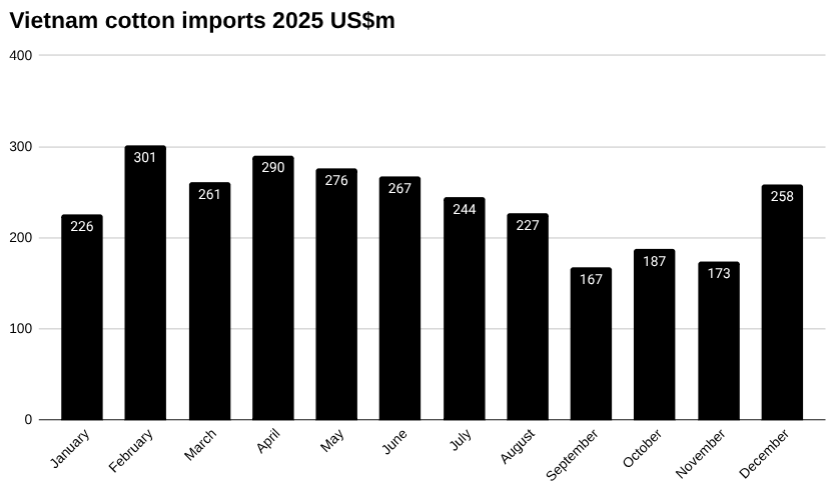
Vietnam imported cotton to the tune of US$258 million in December, up from US$173 million in November, a change of 48.91 percent, according to preliminary data from Vietnam’s General Department of Customs.
Year to date, Vietnam had imported US$2,880 million worth of cotton by the end of December.
The USA accounted for US$96 million worth of Vietnam’s cotton imports in December. This was up from US$55 million in cotton imports in November, a change of 72.85 percent. Year to date, the USA has shipped US$1,367 million worth of cotton to Vietnam.
After the USA was Brazil making up US$66 million worth of Vietnam’s cotton imports in December. This was up from US$47 million in cotton imports in November, a change of 40.50 percent. Year to date, Brazil has shipped US$780 million worth of cotton to Vietnam.
Next was Australia contributing US$57 million worth of Vietnam’s cotton imports in December. This was up from US$50 million in cotton imports in November, a change of 15.13 percent. Year to date, Australia has shipped US$376 million worth of cotton to Vietnam.
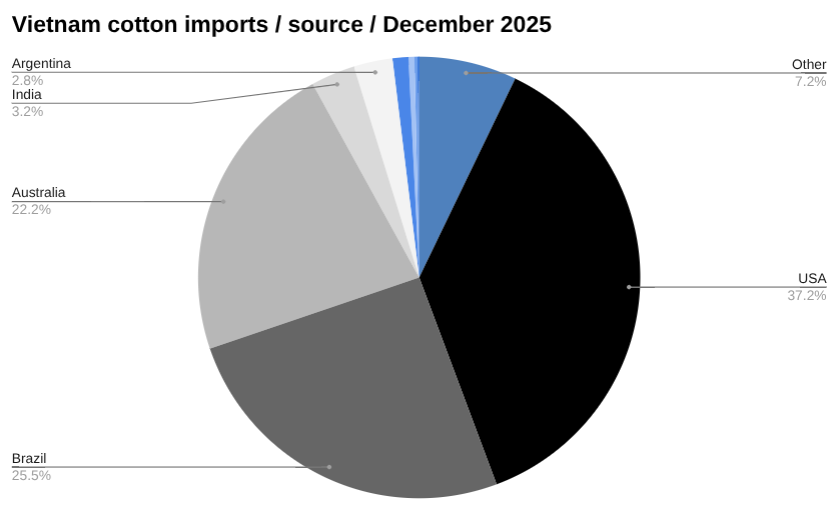
Following Australia was India representing US$8 million worth of Vietnam’s cotton imports in December. This was up from US$6 million in cotton imports in November, a change of 35.68 percent. Year to date, India has shipped US$94 million worth of cotton to Vietnam.
Rounding out the top five was Argentina constituting US$7 million worth of Vietnam’s cotton imports in December. This was up from US$7 million in cotton imports in November, a change of 3.17 percent. Year to date, Argentina has shipped US$49 million worth of cotton to Vietnam.
Learn more about accessing Vietnam’s consumer market→
Vietnam imports of cotton in December, US$m
| December | November | MoM | YTD | |
| Total | 258.14 | 173.35 | 48.91% | 2,880.00 |
| Other | 18.43 | 5.36 | 243.54% | 174.06 |
| USA | 95.91 | 55.49 | 72.85% | 1,366.64 |
| Brazil | 65.75 | 46.80 | 40.50% | 780.30 |
| Australia | 57.36 | 49.82 | 15.13% | 375.53 |
| India | 8.33 | 6.14 | 35.68% | 94.17 |
| Argentina | 7.33 | 7.10 | 3.17% | 49.50 |
| Indonesia | 2.99 | 1.98 | 51.24% | 20.73 |
| Ivory Coast | 1.12 | 0.49 | 126.32% | 15.23 |
| South Korea | 0.56 | 0.16 | 237.39% | 2.87 |
| Taiwan | 0.33 | 0.00 | 0.00% | 0.48 |
| Pakistan | 0.04 | 0.00 | 0.00% | 0.50 |
| China | 0.00 | 0.00 | 0.00% | 1.39 |
Listed garment and textiles companies
Key cotton firms listed on the Vietnam stock exchange include:
Tien Son Thanh Hoa Group
Tien Son Thanh Hoa Joint Stock Company (AAT) operates in export garment production, hotel services, agribusiness, and industrial leasing, with five active factories.
AAT closed at VND 3,350 on Friday up 0.02 percent with 150,000 shares traded, worth VND 50 million.
Foreign ownership in AAT is currently capped at 0.0 percent, with current foreign ownership sitting at 0.0 percent.
Binh Thanh Import Export Production and Trade JSC
Binh Thanh Import Export Production and Trade JSC (GIL) manufactures and exports garments, backpacks, and home goods.
GIL closed at VND 13,750 on Friday down 0.3 percent with 1,098,000 shares traded, worth VND 1,524 million.
Foreign ownership in GIL is currently capped at 50.0 percent, with current foreign ownership sitting at 1.4 percent.
Song Hong Garment JSC
Song Hong Garment JSC (MSH) manufactures and exports garments and textiles for global fashion brands.
MSH closed at VND 35,400 on Friday down 0.45 percent with 3,559,000 shares traded, worth VND 12,594 million.
Foreign ownership in MSH is currently capped at 50.0 percent, with current foreign ownership sitting at 6.4 percent.
Thanh Cong Textile Garment Investment Trading JSC
Thanh Cong Textile Garment Investment Trading JSC (TCM) manufactures and exports garments, yarn, and textiles.
TCM closed at VND 27,200 on Friday down 0.25 percent with 19,211,000 shares traded, worth VND 52,329 million.
Foreign ownership in TCM is currently capped at 50.0 percent, with current foreign ownership sitting at 48.6 percent.
Explore opening a trading account in Vietnam→
Vietnam’s cotton industry
Vietnam’s cotton industry plays a limited role in the textile and garment supply chain, with domestic production covering only a small share of demand.
The sector relies heavily on imported cotton, mainly from the United States, Brazil, and Australia, exposing manufacturers to global price volatility and supply risks.
Find out about starting a business in Vietnam→