
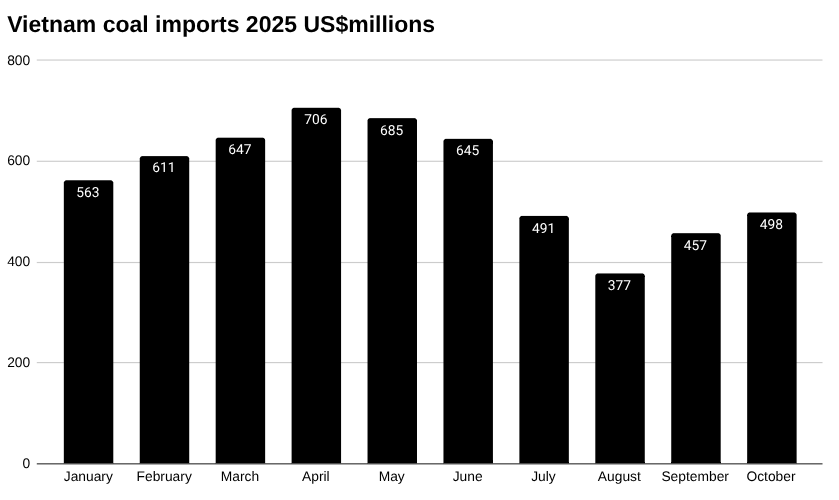
Vietnam imported coal to the tune of US$498 million in October, up 8.83 percent over September, according to preliminary data from Vietnam’s General Department of Customs.
Year to date, Vietnam had imported US$5,663 million worth of coal by the end of October.
In October, Vietnam’s top supplier of coal was Australia, accounting for US$252 million worth. This was up 14.47 percent over September. Year to date, Australia has shipped US$2,285 million worth of coal to Vietnam.
After Australia, Indonesia was the next biggest supplier. It shipped US$143 million worth of coal to Vietnam in October, a fall of 7.34 percent. Its total for the year to date is now sitting at US$1,758 million.
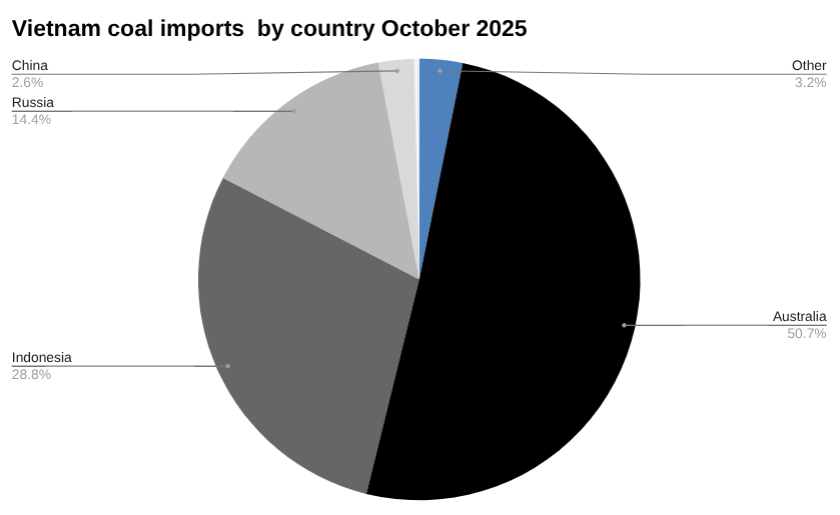
Russia was also a major supplier, shipping US$72 million worth of coal to Vietnam in October. This was a fall of 22.86 percent, for a total of US$716 million for the year.
Rounding out the top five was China with US$13 million, a 91.27 percent change month-on-month, for a total of US$77 million for the year, and Laos with US$2 million, a -48.36 percent change for a total of US$136 million.
Learn more about accessing Vietnam’s consumer market→
Vietnam imports of coal in October, US$millions
| October | September | MoM | YTD | |
| Total | 497.66 | 457.27 | 8.83% | 5,662.53 |
| Other | 15.74 | 13.72 | 14.71% | 690.14 |
| Australia | 252.20 | 220.32 | 14.47% | 2,285.46 |
| Indonesia | 143.18 | 154.52 | -7.34% | 1,757.84 |
| Russia | 71.79 | 58.43 | 22.86% | 716.01 |
| China | 12.92 | 6.75 | 91.27% | 76.64 |
| Laos | 1.82 | 3.52 | -48.36% | 136.16 |
| Japan | 0.02 | 0.00 | 0.00% | 0.08 |
| Malaysia | 0.00 | 0.00 | 0.00% | 0.21 |
Vietnam coal production
Vietnam produced 3.70 million tonnes of coal in October, up 24.44 percent from September, according to the latest data from the National Statistics Office.
Total coal output for the first ten months of 2025 reached 37.64 million tonnes, a 3 percent increase compared with the same period last year.
Production in October was 5 percent lower than the same month in 2024.
Listed coal companies
PetroVietnam Power Corporation
PetroVietnam Power Corporation (POW) operates gas, coal, and hydropower plants supplying electricity to the national grid.
POW closed at VND 15,200 on Wednesday up 0.4 percent with 81,801,000 shares traded, worth VND 123,457 million.
Foreign ownership in POW is currently capped at 50.0 percent, with current foreign ownership sitting at 2.8 percent.
Pha Lai Thermal Power
Pha Lai Thermal Power (PPC) operates coal-fired power plants generating electricity for northern Vietnam.
PPC closed at VND 10,000 on Wednesday down 0 percent with 2,258,000 shares traded, worth VND 2,261 million.
Foreign ownership in PPC is currently capped at 49.0 percent, with current foreign ownership sitting at 4.5 percent.
Explore opening a trading account in Vietnam→
Vietnam coal news
UK-Vietnam energy cooperation
Vietnam Electricity (EVN) and the UK Foreign, Commonwealth and Development Office signed an MOU in London on 30 October to cooperate on green energy and power grid development.
The agreement, witnessed by General Secretary To Lam, forms part of Vietnam’s Just Energy Transition Partnership (JETP) and focuses on applying the UK’s expertise in clean power transmission, HVDC technology, and offshore wind.
It also includes support for reducing emissions at coal plants and strengthening Vietnam’s domestic capacity.
See the latest Vietnam news headlines→
Vietnam’s coal industry
Vietnam’s coal industry plays a central role in the country’s energy security, supplying over one-third of national electricity output.
Major producers include Vinacomin (TKV) and Dong Bac Corporation, which operate dozens of mines across Quang Ninh and the Red River Delta.
Production has stabilised in recent years as the government balances domestic supply with imports to meet rising demand from thermal power plants.
At the same time, Vietnam faces increasing pressure to reduce its reliance on coal in line with global decarbonisation goals.
The revised Power Development Plan VIII targets a gradual shift from coal-fired power toward LNG and renewables by 2050.
However, investment in cleaner technologies and just-transition strategies remains limited, leaving coal an essential but politically sensitive part of Vietnam’s energy mix.