
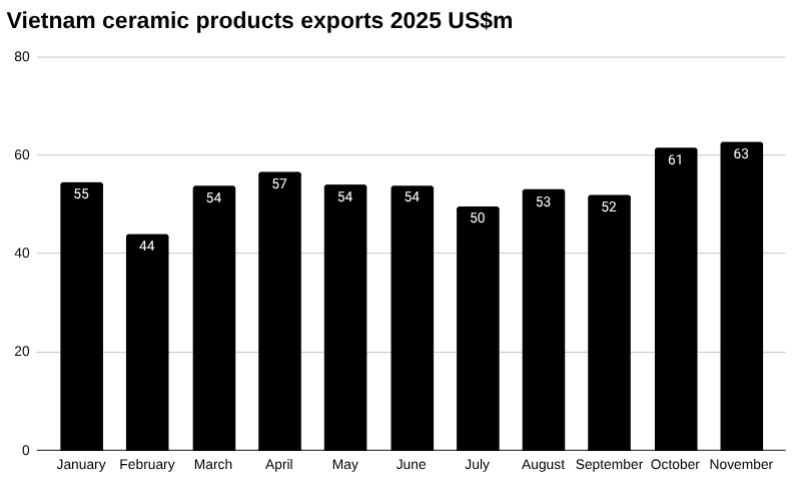
Vietnam exported ceramic products to the tune of US$63 million in November, up from US$61 million in October, a change of 2.18 percent, according to preliminary data from Vietnam’s General Department of Customs.
Year to date, Vietnam had exported US$595 million worth of ceramic products by the end of November.
The USA accounted for US$18 million worth of Vietnam’s ceramic products exports in November. This was up from US$15 million in ceramic products exports in October, a change of 19.01 percent. Year to date, Vietnam has shipped US$148 million worth of ceramic products to the USA.
After the USA was Japan making up US$8 million worth of Vietnam’s ceramic products exports in November. This was up from US$7 million in ceramic products exports in October, a change of 8.20 percent. Year to date, Vietnam has shipped US$81 million worth of ceramic products to Japan.
Next was Taiwan taking US$5 million worth of Vietnam’s ceramic products exports in November. This was up from US$4 million in ceramic products exports in October, a change of 7.03 percent. Year to date, Vietnam has shipped US$58 million worth of ceramic products to Taiwan.
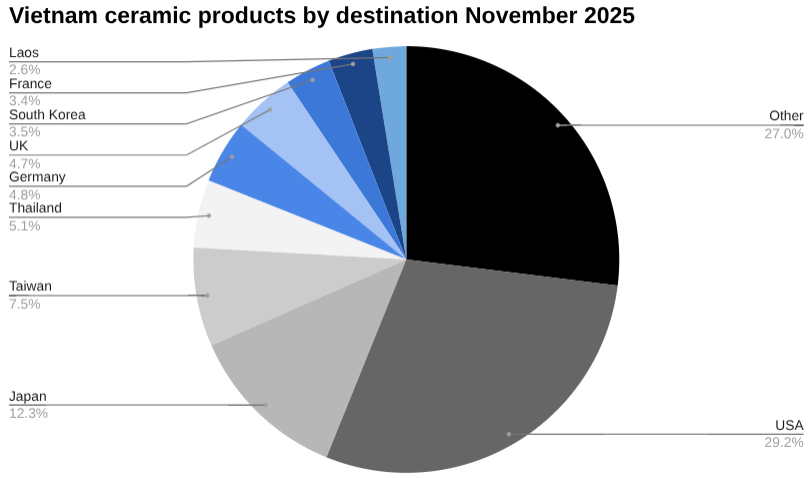
Following Taiwan was Thailand representing US$3 million worth of Vietnam’s ceramic products exports in November. This was down from US$4 million in ceramic products exports in October, a change of -14.66 percent. Year to date, Vietnam has shipped US$36 million worth of ceramic products to Thailand.
Rounding out the top five was Germany constituting US$3 million worth of Vietnam’s ceramic products exports in November. This was up from US$2 million in ceramic products exports in October, a change of 25.27 percent. Year to date, Vietnam has shipped US$16 million worth of ceramic products to Germany.
Learn more about manufacturing in Vietnam→
Vietnam exports of ceramic products in November, US$m
| November | October | MoM | YTD | |
| Total | 62.75 | 61.41 | 2.18% | 595.05 |
| Other | 15.41 | 14.60 | 5.55% | 154.52 |
| USA | 18.30 | 15.38 | 19.01% | 148.04 |
| Japan | 7.71 | 7.13 | 8.20% | 81.17 |
| Taiwan | 4.69 | 4.38 | 7.03% | 57.76 |
| Thailand | 3.23 | 3.78 | -14.66% | 35.96 |
| Germany | 3.04 | 2.42 | 25.27% | 16.17 |
| UK | 2.95 | 3.53 | -16.36% | 29.55 |
| South Korea | 2.18 | 2.74 | -20.17% | 24.74 |
| France | 2.12 | 3.32 | -36.10% | 17.31 |
| Laos | 1.61 | 1.78 | -9.79% | 16.36 |
| China | 1.50 | 2.35 | -36.00% | 13.46 |
| Philippines | 1.47 | 1.65 | -10.66% | 24.76 |
| Cambodia | 1.29 | 1.16 | 11.12% | 7.60 |
| Denmark | 1.22 | 0.33 | 271.38% | 5.41 |
| Australia | 1.14 | 1.51 | -24.36% | 15.14 |
| Netherlands | 1.07 | 1.41 | -23.96% | 11.21 |
| Malaysia | 0.87 | 0.77 | 13.73% | 10.26 |
| Belgium | 0.76 | 0.40 | 92.31% | 2.97 |
| Italy | 0.68 | 1.01 | -32.50% | 9.20 |
| India | 0.38 | 0.44 | -13.03% | 6.17 |
| Singapore | 0.28 | 0.35 | -18.51% | 3.21 |
| Spain | 0.28 | 0.44 | -36.93% | 3.03 |
| Canada | 0.27 | 0.28 | -2.43% | 4.79 |
| Myanmar | 0.14 | 0.27 | -46.77% | 2.01 |
| Sweden | 0.13 | 0.13 | -6.96% | 1.22 |
| Indonesia | 0.10 | 0.34 | -71.56% | 9.30 |
| Hong Kong | 0.08 | 0.03 | 138.06% | 0.72 |
| Russia | 0.06 | 0.08 | -33.53% | 0.58 |
| Argentina | 0.00 | 0.12 | -100.00% | 0.76 |
| Austria | 0.00 | 0.00 | 0.00% | 0.05 |
| Iraq | 0.00 | 0.00 | 0.00% | 0.15 |
Listed ceramic products companies
Viglacera Corporation
Viglacera Corporation (VGC) manufactures building materials, glass, ceramics, and develops industrial parks and real estate.
VGC closed at VND 41,300 on Monday up 0.45 percent with 4,033,000 shares traded, worth VND 16,541 million.
Foreign ownership in VGC is currently capped at 49.0 percent, with current foreign ownership sitting at 2.6 percent.
Explore opening a trading account in Vietnam→
Vietnam’s ceramic products industry
Vietnam’s ceramic products industry is a long-established manufacturing sector, supplying tiles, sanitary ware, tableware and construction ceramics to both domestic and export markets.
It benefits from abundant clay resources, a large skilled workforce and proximity to regional construction demand in Asia.
The industry has increasingly focused on higher-value products, design upgrades and energy-efficient kilns to improve competitiveness.
Export growth is supported by free trade agreements, while producers face rising pressure to meet environmental standards and reduce emissions.