
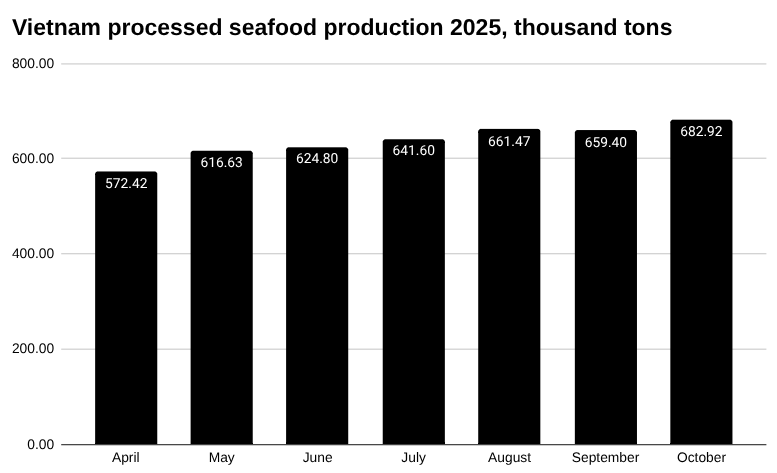
Vietnam produced 682.92 thousand tons of processed seafood production in October, up 3.57 percent from 659.40 thousand tons in September, according to the latest data from the National Statistics Office.
Over the first ten months of the year, output reached 5984.65 thousand tons.
Vietnam seafood exports
Vietnam exported fishery products to the tune of US$1,159 million in October, 14.35 percent over September, according to preliminary data from Vietnam’s General Department of Customs.
Year to date, Vietnam had exported US$9,328 million worth of fishery products by the end of October.
Read the full October Vietnam seafood exports report→

Listed Processed seafood companies
Ben Tre Aquaproduct Import and Export JSC
Ben Tre Aquaproduct Import and Export JSC (ABT) processes and exports frozen seafood products such as clams, shrimp, and pangasius, primarily to European and Asian markets.
ABT closed at VND 73,000 on Friday up 0.8 percent with 141,000 shares traded, worth VND 1,029 million.
Foreign ownership in ABT is currently capped at 50.0 percent, with current foreign ownership sitting at 2.0 percent.
Sao Mai Group Corporation
Sao Mai Group Corporation (ASM) operates in seafood processing, real estate, and renewable energy, notably solar power projects in southern Vietnam.
ASM closed at VND 7,060 on Friday down 0.09 percent with 4,793,000 shares traded, worth VND 3,381 million.
Foreign ownership in ASM is currently capped at 53.9 percent, with current foreign ownership sitting at 13.8 percent.
Camimex Group JSC
Camimex Group JSC (CMX) processes and exports shrimp and other seafood products, primarily to the US, Japan, and EU markets.
CMX closed at VND 6,530 on Friday down 0.12 percent with 1,320,000 shares traded, worth VND 865 million.
Foreign ownership in CMX is currently capped at 0.0 percent, with current foreign ownership sitting at 0.0 percent.
Explore opening a trading account in Vietnam→
Vietnam seafood industry news
“Recipricol” tariffs start to bite seafood industry
Sao Ta Food JSC (FMC) reported Q3 2025 revenue of VND 2.98 trillion or US$114.6 million, up 5 percent year-on-year, and post-tax profit of VND 112 billion or US$4.3 million, up 18 percent, according to reporting from Nguoi Quan Sat.
However, selling expenses doubled to VND 316 billion or US$12.2 million after nearly VND 193 billion or US$7.4 million in reciprocal tax was imposed following the US’s 20 percent levy on Vietnamese goods effective August 7.
Seafood imports
Vietnam spent nearly US$3 billion importing seafood in the first ten months of 2025, mainly from India, Indonesia, and Norway, according to Dau Tu Kinh Te.
The publication quotes VASEP as saying over 600 factories process seafood for export markets, but domestic shrimp and marine supply remain unstable and expensive.
It notes Indian shrimp is 10–15 percent cheaper than Vietnamese products, while Indonesia provides tuna and squid, and Norway exports salmon and cod for premium segments.
War on illegal fishing
Prime Minister Pham Minh Chinh has ordered a nationwide campaign to “declare war” on illegal, unreported, and unregulated (IUU) fishing, warning that local officials will be held personally accountable for violations and delays in removing the EU’s “yellow card”, according to the Market Times.
At the 18th meeting of the National Steering Committee on IUU Fishing, Chinh said the crackdown is vital for national interests and the sustainable development of Vietnam’s seafood industry.
See the latest Vietnam news headlines→
Vietnam’s seafood industry
Vietnam’s fishery products industry is a major export pillar, driven by abundant aquaculture resources and strong global demand for shrimp, pangasius and marine fish.
The sector benefits from expanding farming capacity, improved processing technology and increasing participation from foreign-invested enterprises.
Vietnam has built a wide export network across the US, EU, China, Japan and South Korea.
Ongoing challenges include disease control, feed costs and environmental pressures, but continued investment and regulatory reforms are helping strengthen long-term competitiveness.