
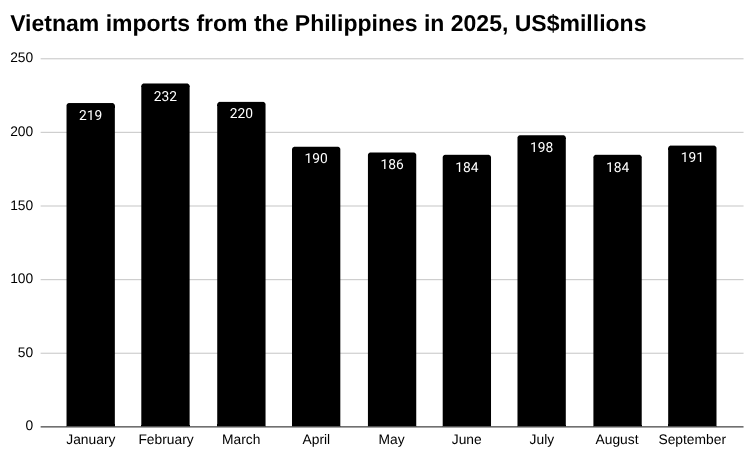
Vietnam’s imports from the Philippines reached US$190.92 million in September 2025, rising 3.72 percent from August, according to preliminary data from Vietnam’s General Department of Customs.
Year-to-date imports totalled US$1.81 billion.
Computers, electrical products, spare parts, and components were the largest category, increasing 1.73 percent month-on-month to US$122.37 million.
Machinery, equipment, tools, and instruments fell 6.55 percent to US$28.89 million, while insulated wires and cables dropped 8.19 percent to US$8.13 million.
Fishery products rose 7.34 percent to US$3.90 million, and vehicle parts climbed 23.01 percent to US$2.79 million.
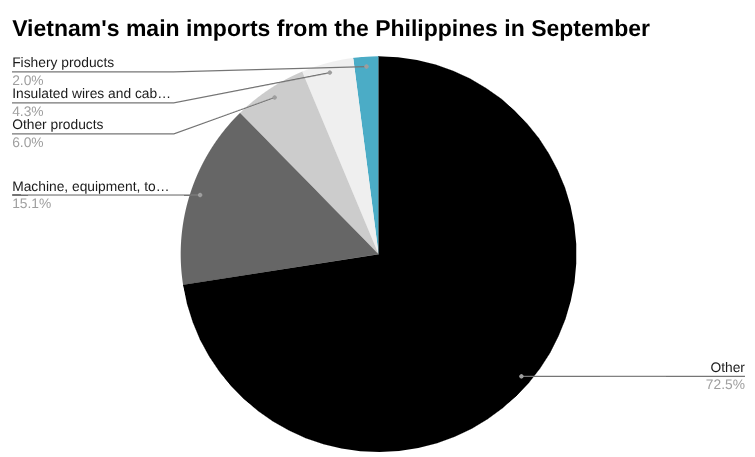
Iron and steel products declined 31.52 percent to US$2.91 million, while fertilizers re-entered trade flows with US$2.24 million in imports.
Animal fodders jumped sharply by 429.21 percent to US$1.71 million, and pastries, sweets, and cereal products increased 26.33 percent to US$1.37 million.
Learn more about selling products in Vietnam→
Vietnam imports from Philippines in September 2025, US$millions
| September | August | MoM | YTD | |
| Total | 190.92 | 184.08 | 3.72% | 1,805.71 |
| Computers, electrical products, spare-parts and components thereof | 122.37 | 120.29 | 1.73% | 1,115.30 |
| Machine, equipment, tools and instruments | 28.89 | 30.92 | -6.55% | 268.50 |
| Other products | 11.53 | 7.38 | 56.22% | 110.86 |
| Insulated wires and cables | 8.13 | 8.85 | -8.19% | 73.12 |
| Fishery products | 3.90 | 3.64 | 7.34% | 34.89 |
| Iron and steel products | 2.91 | 4.25 | -31.52% | 22.98 |
| Parts and accessories of motor vehicles | 2.79 | 2.27 | 23.01% | 19.31 |
| Fertilizers | 2.24 | 0.00 | 0.00% | 6.51 |
| Animal fodders and animal fodder materials | 1.71 | 0.32 | 429.21% | 8.32 |
| Pastries, sweets and cereal products | 1.37 | 1.09 | 26.33% | 11.83 |
| Iron and steel | 1.27 | 1.32 | -3.44% | 11.00 |
| Plastic products | 1.13 | 1.19 | -4.77% | 11.86 |
| Plastics | 1.03 | 0.59 | 75.60% | 7.72 |
| Other base metal products | 0.69 | 0.54 | 26.69% | 4.23 |
| Chemical products | 0.30 | 0.49 | -38.49% | 4.86 |
| Rubber products | 0.17 | 0.19 | -8.50% | 1.65 |
| Pharmaceutical products | 0.15 | 0.06 | 158.27% | 0.39 |
| Other edible food preparations | 0.13 | 0.31 | -59.47% | 2.38 |
| Tobacco materials | 0.08 | 0.11 | -31.04% | 1.75 |
| Ferrous waste and scrap | 0.07 | 0.14 | -48.77% | 3.08 |
| Paper | 0.03 | 0.08 | -62.41% | 0.26 |
| Essential oils and resinoids; perfumery, cosmetic | 0.02 | 0.00 | 0.00% | 0.21 |
| Fabrics | 0.00 | 0.02 | -100.00% | 0.13 |
| Milk and milk products | 0.00 | 0.00 | 0.00% | 0.15 |
| Other base metals | 0.00 | 0.03 | -100.00% | 84.42 |
Vietnam trade with the Philippines
Vietnam’s total trade with the Philippines reached US$537.81 million in September 2025, down 28.34 percent from August.
Exports fell sharply by 38.76 percent to US$346.89 million, while imports rose 3.72 percent to US$190.92 million.
The trade balance remained in Vietnam’s favour at US$155.97 million, though this was a 59.21 percent decline from the previous month.
Year-to-date, bilateral trade totalled US$6.09 billion, with Vietnam exporting US$4.28 billion and importing US$1.81 billion.
Vietnam trade with Philippines September 2025 US$millions
| September | August | MoM | YTD | |
| Imports | 190.92 | 184.08 | 3.72% | 1,805.71 |
| Exports | 346.89 | 566.40 | -38.76% | 4,283.68 |
| Total | 537.81 | 750.48 | -28.34% | 6,089.39 |
| Balance (Vietnam) | 155.97 | 382.33 | -59.21% | 2,477.97 |
Vietnam-Philippines trade relations
Vietnam and the Philippines maintain a strategic trade partnership grounded in complementary strengths.
Vietnam primarily exports rice, cement, machinery, and electronics, while importing computers, electrical components, and equipment from the Philippines.
The two countries cooperate under a strategic partnership framework and both are members of ASEAN and the Regional Comprehensive Economic Partnership, enhancing trade integration.
Vietnam consistently records a trade surplus, supported by strong agricultural and manufacturing exports.
Challenges include logistical costs, regulatory barriers, and the Philippines’ periodic rice import restrictions, yet both sides continue to expand cooperation in technology, infrastructure, and processed goods to strengthen regional supply chains.