
April saw Vietnam’s energy stocks fall sharply even as global oil prices surged, as government fuel price caps prevented companies from passing on rising costs.
April was an interesting month for Vietnam’s stock market, with the war in Iran pushing up fuel prices, but energy stocks generally declining, with the VNAllShare Energy Sector Index (VNENE) losing about 11 percent.
This stands in contrast to the S&P Global 1200 Energy Index, which was up 1.53 percent over the same period.
This disparity was largely the result of adjustments to regulation fuel price caps failing to keep up with the erratic movements of world energy prices, Petrolimex CEO, Luu Van Tuyen, told the company’s annual general meeting.
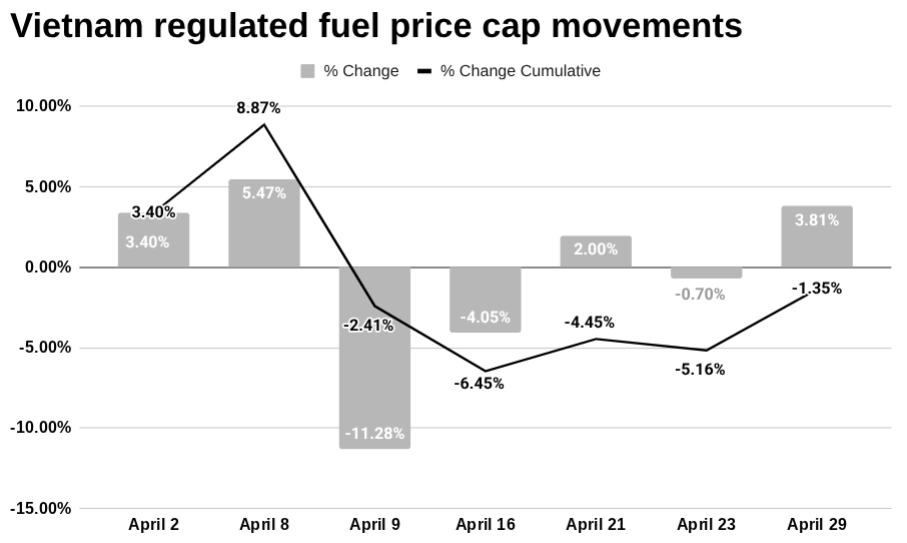
He also said the company, Vietnam’s biggest petrol retailer, was expecting to record a loss in the first quarter of 2026 of about VND 1 trillion (US$38 million), framing it as part and parcel with fulfilling its “national responsibilities” of ensuring Vietnam’s energy supply.
Note that Petrolimex is listed on the HoSE, but is majority-owned by the Vietnamese government.
Incidentally, an ACB Securities report released days later estimated that Petrolimex would make a profit of VND 3.69 trillion (US$140 million) in 2026, highlighting the challenge of assessing state-owned firms’ finances against free market principles.
Nevertheless, the VN-Index continued to climb, gaining 159 points, about 9.4 percent.
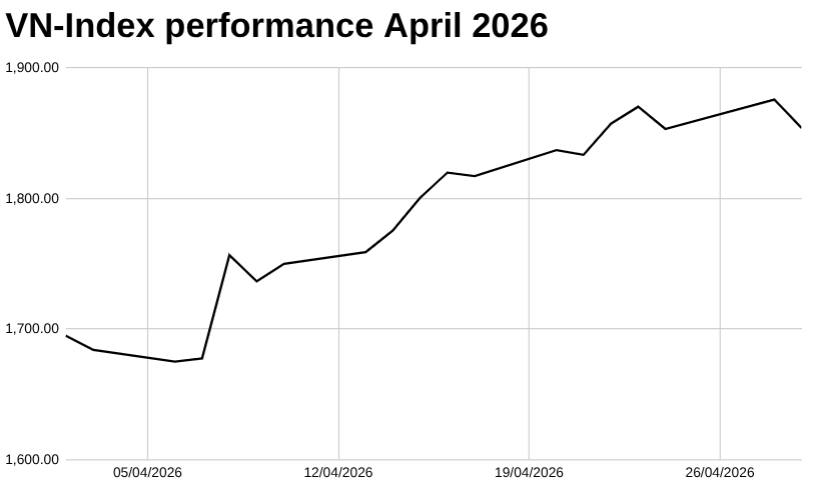
As has become the norm over the last year or so, this was largely powered by the Vin-family of stocks. Vingroup, Vinhomes, and Vincom Retail all record gains — 58.5 percent, 41.8 percent, and 25.4 percent, respectively.
This is all the more impressive in that Vingroup was trading at up to 10.7 times its book value at times, though with no major announcements to speak of that would justify paying a premium.
It also released its Q1 financial statements that showed no significant changes in its precarious financial situation — if anything, it seemed to deteriorate, with total liabilities reaching 6.6 times equity, up from 6.4 in the fourth quarter of last year.
All of that said, the stock market across the board did receive a small moral boost when FTSE Russell confirmed it would be upgrading the Ho Chi Minh City Stock Exchange from a frontier to a secondary emerging market.
But whereas the excitement in the local press was palpable with estimates suggesting foreign capital inflows could get as much as a US$6 billion boost, the reality is that this is about the same amount of foreign capital that has exited the market since January 1 of last year. It’s also well below the roughly US$9.6 billion that has left the market since January 1 2024.
Of course, these outflows have had little impact on the market’s overall capitalisation, which had reached VND 8,726.07 trillion (US$331.16 billion) by the end of April, an increase of VND 718.33 trillion (US$27.26 billion) over the start of the month.
On that note, the Deputy Prime Minister Nguyen Van Thang told a conference that the government wants to see the market capitalisation of the stock exchange reach 120 percent of GDP by 2028.
It’s not clear how serious of a target this is; however, it could be indicative of a loosening of listing requirements coming down the pipeline. It’s also not a stretch to think that this might encourage regulators, should it be pursued with vigour, to take a more relaxed approach to enforcing stock exchange rules that might lead to delistings.
The Ministry of Public Security also floated the idea of directing local news outlets and influencers to skew coverage of the market to the positive side.
This was only in a proposal sent from the MPS to the Prime Minister, not an official policy move, but then it doesn’t need to be official policy to still be effective, with self-censorship being a key component of Vietnam’s media management machine.
Traders, therefore, should see this as yet another reminder that information flows are regulated in Vietnam and that local reporting should always be taken with a grain of salt (you can contribute to the-shiv here FYI).
Moving forward, inflation figures released this week recorded an uptick of 5.46 percent year-on-year. This is nearly a full percentage point above the State Bank of Vietnam’s 4.5 percent target.
This was to be expected — not only has the war in Iran inflated fuel prices, but the government has been actively urging banks to keep interest rates low as it strives to hit a 10 percent GDP growth target for the year.
As yet, it’s not clear how or if this might be addressed; however, the short-term gains from keeping interest rates low are quickly closing the gap on the long-term problems this creates, and with limited foreign currency reserves, an interest rate hike might soon be the only option.