
Few industries in Vietnam are feeling the impact of the closure of the Strait of Hormuz more than tourism, with higher fuel prices leading to a decline in international arrivals and delaying new resort and hotel projects due to fuel shortages and higher construction costs.
Vietnam welcomed 21 million international tourists last year, its highest annual figure ever. This year, the government is hoping to see that increase to 25 million.
But rising fuel prices are creating problems for the industry, with international arrivals dipping month-on-month in March by 6.7 percent, and then again in April by another 2.3 percent.
This fall has been almost across the board, with only the Africa and the Australia and New Zealand markets seeing numbers climb, though from low bases relative to the other major tourist channels.
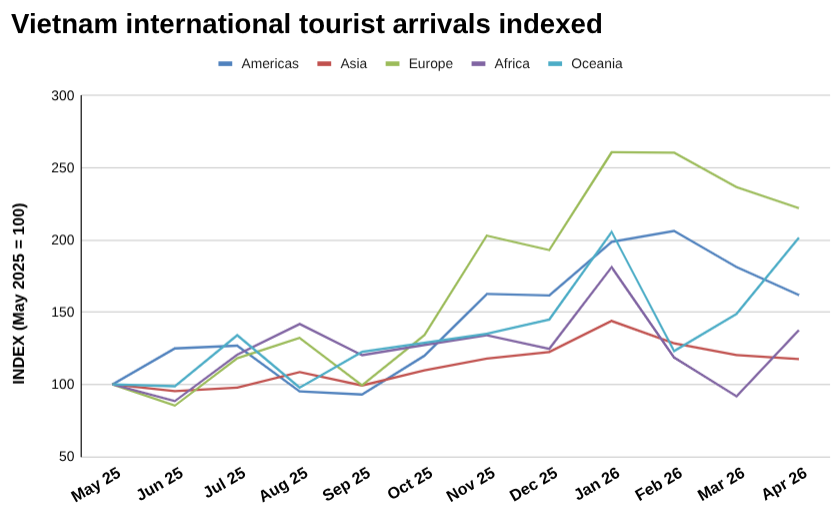
Interestingly, this is noticeable on the ground, too, with John Gardner, CEO and Founder of Optimum Hospitality, an industry consultancy, telling the-shiv, he thinks Australian travellers are being put off by the higher airfares to Europe, instead looking for holiday destinations closer to home, like Vietnam.
For tourists from the Western Hemisphere, however, he says he is seeing the opposite effect, reporting a decline in European visitors, in particular.
Indeed, arrivals from Europe in April were down 6.1 percent over March and down 14.86 percent from their 12-month peak in January.
These numbers could also be set to slide further.
“The bookings that were already made, some months ago from Europe in the long haul, they have been continuing, but there are no sort of new bookings coming up, or very few,” Gardner said.
It does not just seem to be confined to Europe and the Americas, either.
“Even business coming from Korea, which is actually one of the biggest inbound markets into Vietnam, has also dropped quite a bit,” he said.
Korean visitors accounted for just 320,000 international tourist arrivals in April, down 9.9 percent over March.
“And there are a lot of resorts that relied significantly on the Korean business. They are hurting quite a bit.”
That said, these short-term impacts may be limited with travel behaviours expected to shift, says Nuno F. Ribeiro, formerly of RMIT Vietnam, now an Associate Professor of International Tourism and Hospitality Management at Copenhagen Business College.
“Whenever there is less money or less discretionary income, people do not stop travelling. They just travel to other places, or they will travel with lesser frequency… Instead of taking multiple trips during the year, they will take fewer trips but longer ones because that is more cost-effective,” he told the-shiv.
He also notes that not all travellers are affected.
“We are seeing that, as almost always, higher-end travellers — luxury travel — is almost immune to economic shocks.”
That aside, he does go on to say that this could have an impact on industry development more broadly, pointing out that uncertainty impacts capital allocation, which could delay new resort and hotel developments around the country.
Gardner, incidentally, made a similar observation, adding that construction cost increases are also becoming problematic.
“I know that in some cases, some of those projects that have been under construction have either been put on hold or they have slowed right down because they just cannot afford to proceed,” he said.
“This has happened quite a bit, particularly in Phu Quoc, and I heard also in some new resort areas in Da Nang and further north.”
Notably, Phu Quoc’s challenges have been widely reported in the domestic press, on account of the island set to host the Asia Pacific Economic Cooperation (APEC) 2027 summit next year.
A number of projects underway on the island for the event are reporting cost blowouts, as transport costs from the mainland to the island spike.
Fuel suppliers are even, in some cases, reportedly avoiding shipping fuel to the island altogether, to the point that project developers have, at times, reported fuel shortages of as much as 10,000 litres per day.
Framed as a showcase for the island’s tourist value, a failure to meet expectations at the summit could have wide-reaching implications for the tourism industry more broadly.
The summit is, however, still 18 months away, with an end to the war likely to assuage a lot of these concerns.
But with no clear pathway to an ending in sight, Gardner says the industry can’t do much more than simply wait.
“I think a lot of people are just in this holding pattern… hoping that this whole crisis gets over quickly,” he said.