
The National Statistics Office (NSO) has released its February data, with Vietnam’s economy performing generally as expected. However, this data has been made all the more important by the conflict in Iran that began on February 28.
That is, the conflict is having a significant impact on global energy markets, with the economic effects likely to begin to show in the March data.
The performance of Vietnam’s economy in February will, therefore, likely be used as a baseline against which the impacts will be measured.
Keep in mind, however, February was a shorter month and included the Lunar New Year break, which ran from February 15 to February 22, and saw most of the government and industry shut down for its duration.
This has distorted this data somewhat, though when accounted for, it does look mostly on trend.
With all of this in mind, this article runs briefly through what the data says about the performance of Vietnam’s economy in February.
Overall trade was down, but the deficit was on trend.
In February, total merchandise exports and imports reached US$67.16 billion, down 24.1 percent from the previous month but up 5.1 percent year-on-year.
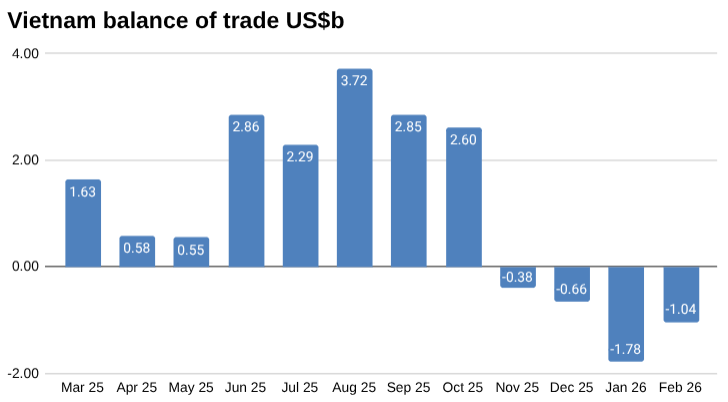
Exports totalled US$33.06 billion, while imports reached US$34.1 billion, leaving a trade deficit of US$1.04 billion.
Since November, Vietnam has seen a persistent trade deficit, which, underneath the significant fall in trade due to the Lunar New Year, would put February largely on trend.
Foreign direct investment
Total registered foreign investment, including newly registered capital, adjusted capital for existing projects, and foreign investors’ capital contributions and share purchases, reached US$6.03 billion in the first two months of 2026, down 12.6 percent from a year earlier.
Note that this is averaged over the first two months of the year, which should mitigate any fluctuations caused by the Lunar New Year holiday.
Broken down, new projects and investment were actually up; it was adjusted capital for existing projects, and foreign investors’ capital contributions and share purchases, that pulled growth down.
Manufacturing conditions were improving.
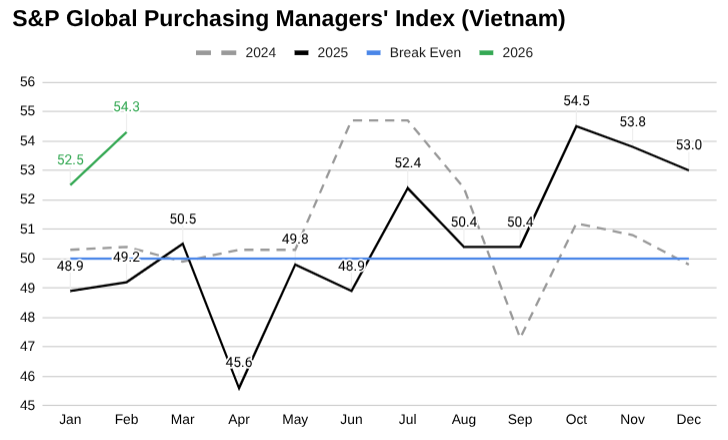
Vietnam’s manufacturing sector extended its recovery in February, with the headline Purchasing Managers’ Index rising to 54.3 from 52.5 in January, signalling a solid improvement in business conditions, according to a press release from S&P Global.
Business confidence also improved for a fifth consecutive month, reaching its highest level since September 2022 as firms anticipated further output gains over the coming year, the release says.
The local currency continued to strengthen
The State Bank of Vietnam’s central exchange rate, Google’s mid-market rate, and the black market rate all trended stronger in February.
This looks set to reverse course moving into March, with a strengthening US dollar incentivising US dollar holders to avoid buying dong until a floor is found.
Though, of course, the currency doesn’t float freely, so there is every chance the SBV might intervene to prevent this from happening.
Inflation edged higher
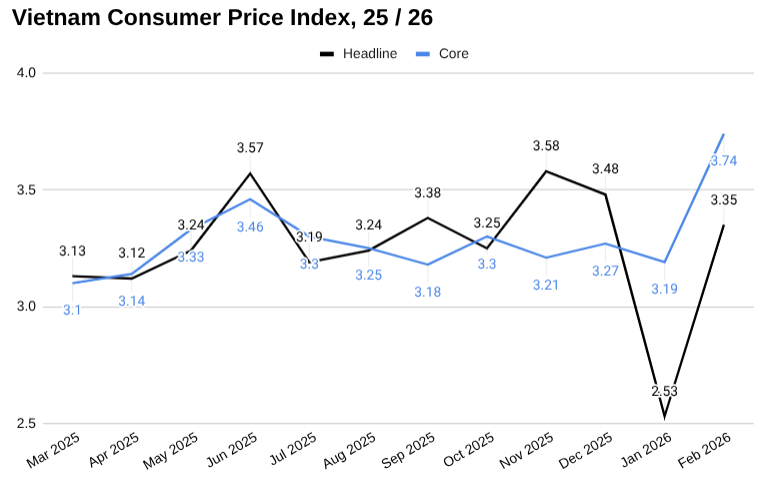
Inflation was a whisker above the 12-month moving average of 3.28 percent, coming in at 3.35 percent year-on-year.
The NSO attributed this to food, dining and transport cost increases during the Lunar New Year holiday
Core inflation, which excludes food and energy prices, rose 3.47 percent over the same period, which, for the second month in a row, outstripped headline inflation. This might suggest stronger underlying price pressures, with regulated energy pricing possibly helping to keep headline inflation slightly lower.
The stock market continued to climb.
The VN-Index finished February up about 3 percent.
Foreign traders, however, continued to exit the market, net-selling about US$116.9 million worth of stocks. This was also on trend — since the start of last year, about US$5.13 billion has been net-withdrawn by foreign investors.
Of note, a new circular was introduced in February, allowing foreign investors to trade securities via global brokers without opening local brokerage accounts.
It also allows foreign fund managers to open multiple trading accounts and removes limits on the stocks that can be purchased, without foreign traders required to pre-fund their trades.
This is in line with an FTSE review scheduled for March that will decide if the local bourse will be upgraded from a frontier market to a secondary-emerging market in September.
The first week of March
All of that said, on February 28, the United States and Israel attacked Iran. This has thrown global energy markets into uncertainty and pushed crude oil prices higher.
This will weigh heavily on Vietnam’s economy — about a third of its fuel comes from one refinery that is configured to process crude oil from Kuwait. If the conflict in Iran wears on, this could have a significant impact on the local energy supply.
Despite reassurance from the government that fuel supplies will not be disrupted, there are few signs of a cogent plan to ensure this is the case, although there generally aren’t a lot of options other than simply paying more.
That is to say, March is shaping up to be a challenging month.
Further reading: