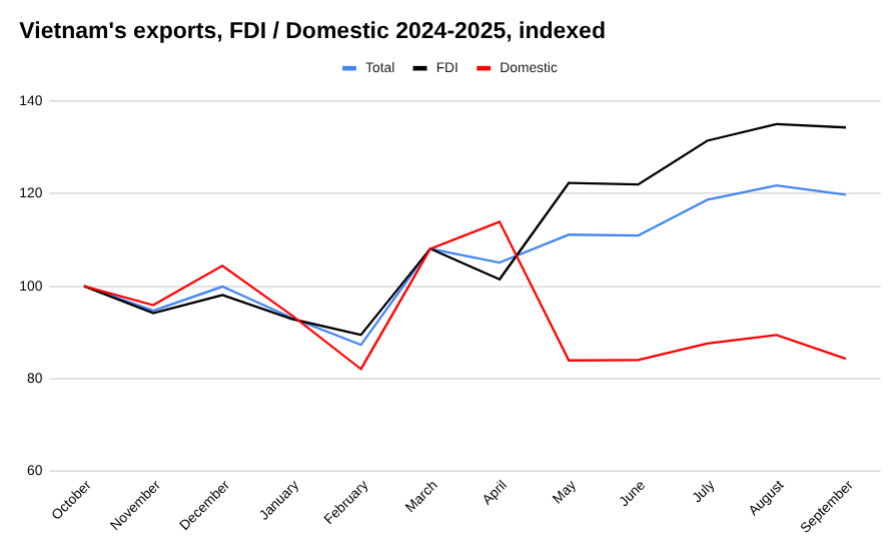
Locally owned firms have seen their share of Vietnam’s exports fall this year from about 30 to just over 20 percent. This is an anomaly in that it is out of proportion with a boom in exports overall. So what happened? And what does it mean?
Between April and May of this year, Vietnamese-owned exporters saw their share of Vietnam’s export trade cut significantly.
Specifically, whereas domestic firms had accounted for 31.5 percent of Vietnam’s total exports in April, that number dropped to just 22 percent in May, according to preliminary data from Vietnam’s General Department of Customs.
This was not a one-off, either.
In the five months since, with the exception of June (which reached 22.04 percent), the share of exports attributed to domestic firms has continued to fall — in September it was down to just 20.5.
This comes at a volatile time for the global trading environment, amid a government push to strengthen Vietnam’s domestic private sector, and alongside significant economic growth numbers, all of which seem somewhat incongruous.
That being the case, this article attempts to put all these pieces together and elucidate one of the lesser talked about, yet bigger changes in Vietnam’s export sector this year.
It's free to keep reading but you will need to sign in.
Of course, it makes sense to assume that FDI exports jumped in order to get in under the line before the Trump tariffs kicked in and that this, by extension, lowered the share of exports of domestic firms.
And this looks to be part of the answer.
Exports to the United States averaged US$10.7 billion a month in the 12 months up to and including April. In the five months after, that number was US$13.9 billion.
This was also part of a bigger jump in total exports, which by the same measure went from an average of US$35 billion to an average US$42.5 billion a month.
However, this only tells part of the story, in that Vietnamese firms’ exports didn’t just fall as a percent of total exports, but also in dollar terms, too.
From May last year to April this year, locally-owned firms accounted for an average of US$10.5 billion worth of Vietnam’s exports a month.
In May, however, that number fell to just US$8.7 billion, with an average of US$8.9 billion over the five months since.
Of course, the proximity of this dip to the US tariff announcement in April does seem conspicuous; however, it’s important to remember that correlation doesn’t necessarily mean causation.
With this in mind, it’s worth taking a second to consider where those declines have been recorded.
Firstly, machines and equipment saw the biggest fall in export revenue for domestic firms, averaging a decline of US$96.9 million a month since April.
This was followed by computers and electrical products, coffee, digital cameras, and rice, which averaged monthly declines of US$85.6 million, US$79.6 million, US$51.7 million, and US$49.7 million, respectively.
Collectively, these five categories accounted for about 89 percent of the overall average monthly decline of US$406.3 million.
Of course, coffee is seasonal and often fluctuates with global markets. Moreover, total exports of coffee fell overall over the same period, so this doesn’t seem significantly out of the ordinary.
It’s in computers and electrical products, digital cameras, and machines and equipment, however, that these sharp declines look out of place. This is particularly pertinent in the context that total exports of all three jumped significantly over the same period — growing on average 5.3 percent, 6.23 percent, and 20.9 percent, respectively.
This could be written off as changes in ownership structures, mergers and acquisitions with, or by, foreign firms, for example. Local firms registering their businesses offshore and operating as foreign-owned entities in Vietnam is not uncommon, too.
There were, however, average declines in 34 of the 46 product lines the customs department reports on, so while this might explain some, it’s difficult to see it explaining all.
Suffice it to say, given the size of the drop, the very short time frame within which it has taken place, and the breadth of the categories of exports impacted, it looks much more like the result of broader environmental factors.
On that note, there is one obvious big change that has taken place, and that was the announcement by the Trump administration that it would raise import tariffs to close trade gaps and stymie trans-shipping.
But again, correlation does not necessarily mean causation.
That said, why this happened does not seem as important as what this might mean.
The broad strokes of Vietnam’s economic growth plan put forward at the start of the year were to increase the role of domestic private enterprises in the economy through low interest rates and private credit.
Whereas the latter has largely been fulfilled, realising the former, looking at this particular set of data, may be more complicated than seems to have been hoped.
It also means an increased dependence on foreign firms at a time when global trade conditions are far from certain.
Notably, it’s a common response for the government to draw on nationalist sentiment to compel business leaders to pitch in and help out in times of crisis. This works well for local firms, foreign firms, however, don’t tend to have that same kind of connection to the country.
To extrapolate on that further, it’s also worth thinking about, if not Vietnam, where do the allegiances of key decision makers at these export firms lie? And what might this mean for the country, geopolitically speaking?
A question particularly important as trade conflict between the United States and China, Vietnam’s two biggest trading partners, heats up.
That is to say, this emerging new paradigm, where Vietnamese firms lay claim to a lesser share of Vietnam’s exports, adds an interesting new layer to Vietnam’s current economic dynamic that could be a sign of bigger challenges to come.
In today’s news: SBV raises loan-to-deposit cap, Fuel tax cut extension, Denmark jewellery factory opens, Taiwan cooling system manufacturer expansion, SK firm gas power
In today’s news: Long Thanh passenger fees, Violent short film producers fined, Innovation index improvement, Hanoi pilotless aircraft sandbox under consideration, Power project Japan
This is an interview with Dr Nuno F. Ribeiro, Associate Professor, International Tourism & Hospitality Management at Copenhagen Business College, formerly of RMIT Vietnam. It