
Vietnam’s garment and textile exports fell short of expectations in 2025. Is this a sign that Vietnam’s garment and textile industry may have peaked?
At its peak, garment maker Garmex Saigon had five factories and 4,000 staff, with revenue in 2018 of US$87.8 million.
Fast forward to 2023, however, and it had shut down the last of its production lines, laying off almost all of its staff.
Skip forward again, to 2026, and the company is now making its money from pickleball court rental with no garment orders to speak of.
This has led to a lot of speculation as to the future of Vietnam’s garment and textile industry in the local press.
So, what does that future actually look like?
Firstly, Garmex Saigon seems to be generally an outlier, with textiles and garments still Vietnam’s fourth biggest export in 2025.
The sector did, however, fall short of expectations, which fits in line with a generally slower growth environment emerging.
On a nominal basis, that’s not exactly clear — Vietnam’s textile and garment exports increased from US$32.8 billion in 2021 to US$39.6 billion last year, a 21 percent increase.
However, deflating those figures using the Federal Reserve Bank of St. Louis Apparel Producer Price Index — a US-based measure, but a reasonable proxy given the US is Vietnam’s largest export market — reduces that increase to just 4.15 percent.
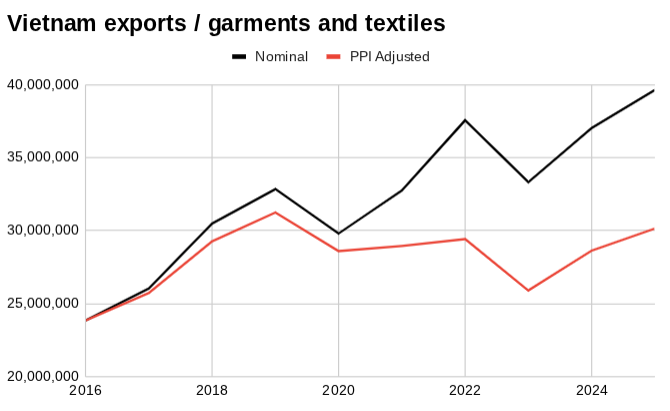
To look at it from another angle, the revenues of Vietnam’s biggest listed garment and textile makers have also shown significant growth on a nominal basis, registering a 58 percent jump from 2021 to 2025, though just 20 percent when adjusted.
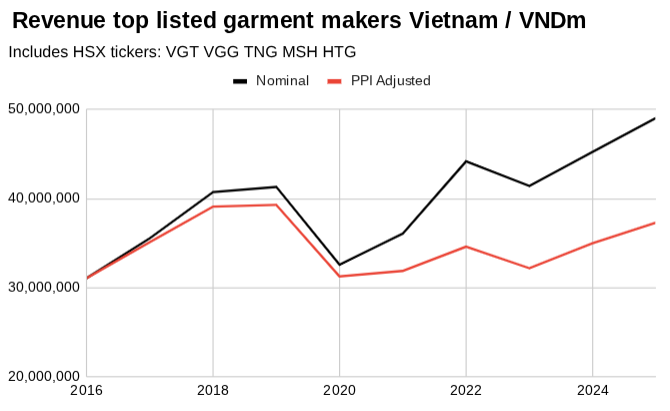
That is, headline data might reflect solid growth, but in volume terms it actually looks much more muted.
This would make sense, too, with Vietnam’s competitive edge slowly being whittled away.
The average salary in the manufacturing sector, for example, in the fourth quarter of 2025, was about US$331 a month.
By comparison, in key competitor Indonesia, it was just US$188 — about 40 percent cheaper — and in Bangladesh, also a key garment manufacturing hub, as of 2023, it was just US$94 — less than a third that of Vietnam.
On that note, Bangladesh’s industry has also benefited from the rapid devaluation of its local currency against the greenback. Of course, this is in large part for political reasons, though that’s not to negate the generally stronger US dollar over the last half-decade or so.
The dong, by contrast, has only devalued marginally, relatively speaking, on the back of State Bank of Vietnam ForEx interventions.
This has kept Vietnam’s exports relatively expensive and added uncertainty for manufacturers attempting to hedge currency risk.
Then there is US trade policy, which has seen Vietnam slapped with tariffs higher than many of its regional competitors, alongside being flagged as an intermediary for Chinese firms trying to circumvent US tariffs.
On the latter, it may be facing a possible 40 percent tariff on those goods, the uncertainty around which, on its own, increases the country’s risk profile; that’s not to say what might happen if it actually goes ahead.
Moreover, the European Union, also a significant export market, has just signed trade agreements with South America’s Mercosur trading bloc and India, both of which count low-cost labour among their competitive advantages in global trade.
On that note, in 2025, US$24.7 billion worth of Vietnam’s garment and textile exports were attributed to foreign-invested firms.
Many of these firms didn’t start out producing garments in Vietnam but transferred their operations from what were once low-wage jurisdictions — Taiwan, Singapore, and China, for example — in search of lower production costs.
Notably, of Nike suppliers, the top 10 factories in Vietnam, in terms of the number of employees, are all foreign-owned.
The point being that any argument that future growth might be powered from within looks weak in this context.
Moreover, Vietnam’s five biggest garment makers’ collective revenue in 2025 was just VND 38.6 trillion or about US$1.85 billion, which is not even 5 percent of Vietnam’s total garment and textile exports.
It’s also only about 16 percent of garment and textile exports accredited to local firms (US$11.3 billion in 2025), which speaks to the level of fragmentation in the sector, with a heavy dependence on small suppliers.
This matters for the fact that there are few firms that might be able to scale to the size of a big, multinational foreign producer.
The biggest listed garment and textile maker, Vinatex, is also mostly state-owned, with economic and political implications if it were to look at expanding outside of Vietnam.
All of that is to say, if Vietnam’s garment and textile manufacturing hasn’t peaked yet, on its current trajectory, it seems like it probably will soon.
And this points to an uncomfortable reality: for all the talk of skills transfers and building homegrown multinationals, in an industry in which it is at the forefront, it does not seem to have made much progress toward realising domestic powered growth.
This then raises the question: is the trajectory of Vietnam’s garment and textile sector a confined anomaly or indicative of broader constraints facing Vietnam’s economic development?
The data
Revenue (Vietstock)
| 2016 | 2017 | 2018 | 2019 | 2020 | 2021 | 2022 | 2023 | 2024 | 2025 | |
| PPI (12-month average) | 143.358 | 145.067 | 149.325 | 150.7 | 149.40 | 162.21 | 183.04 | 184.46 | 185.40 | 188.50 |
| Revenue VNDm | 31,065,390 | 35,544,413 | 40,727,084 | 41,298,649 | 32,579,814 | 36,065,919 | 44,175,097 | 41,409,205 | 45,234,090 | 49,047,483 |
| PPI Adjusted | 31,065,390 | 35,125,673 | 39,099,637 | 39,286,607 | 31,262,229 | 31,874,545 | 34,598,384 | 32,181,917 | 34,977,204 | 37,300,795 |
Exports (Vietnam General Department of Customs)
| 2016 | 2017 | 2018 | 2019 | 2020 | 2021 | 2022 | 2023 | 2024 | 2025 | |
| PPI (12-month average) | 143.358 | 145.067 | 149.325 | 150.7 | 149.40 | 162.21 | 183.04 | 184.46 | 185.40 | 188.50 |
| Nominal | 23,841,360,598 | 26,038,446,767 | 30,488,693,065 | 32,850,225,308 | 29,809,802,310 | 32,753,598,665 | 37,566,645,537 | 33,329,144,538 | 37,036,851,951 | 39,641,806,150 |
| PPI Adjusted | 23,841,360,598 | 25,731,693,987 | 29,270,370,403 | 31,249,785,001 | 28,604,241,229 | 28,947,163,212 | 29,422,577,543 | 25,902,351,176 | 28,638,699,774 | 30,147,742,467 |