
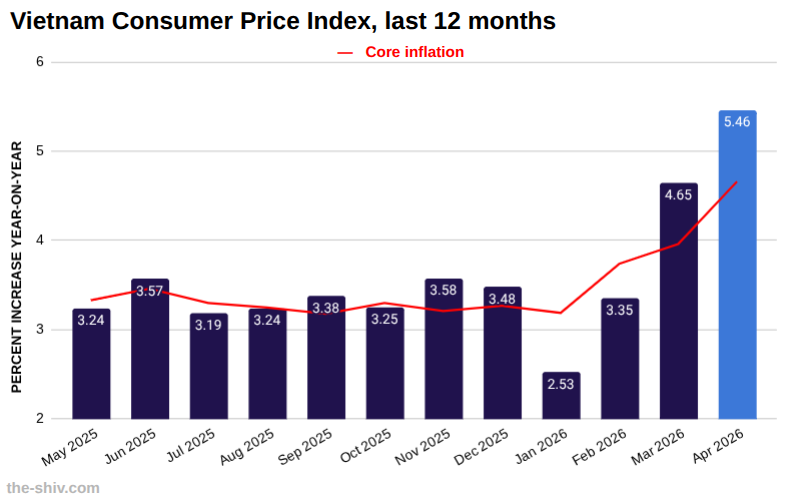
Inflation in Vietnam hit 5.46 percent in April, well above the Government of Vietnam’s target of 4.5 percent. Elsewhere, this might be seen as a sign to take evasive action through interest rate policy, but in Vietnam monetary policy dynamics are markedly different.
Vietnam recorded inflation in April, the highest it has seen in six years, at 5.46 percent.
This was partly off the back of the fuel crisis resulting from the war in Iran, though the Ministry of Finance has said that it was expecting planned increases in healthcare fees and tuition, alongside higher electricity demand over summer, to drive inflation higher regardless.
It has even forecast prices rising by as much as 5.5 percent this year, a full percentage point higher than the government’s target of 4.5 percent.
But raising interest rates to try to ease price pressure, a fairly standard move in most economies, faces unique challenges in Vietnam.
Specifically, it will mean slower growth, with an increased risk of the government missing a self-imposed 10 percent GDP growth target for the year, a target officials continue to frame as central to the country’s development.
Moreover, it would mean higher debt financing costs for an economy currently carrying a significant debt burden. At the end of last year, private debt was more than VND 18.40 quadrillion (US$698.3 billion), about 140 percent of Vietnam’s GDP.
It would also temper demand as consumers tighten their belts, so business would have not only higher financing costs but also fewer customers.
The alternative, however, doing nothing, is also problematic.
Higher inflation erodes household purchasing power.
If consumers are buying less, then businesses need to produce less, which means they need fewer employees.
With their wages no longer going as far, workers are also likely to see their quality of life deteriorate.
The Global Living Wage Coalition estimated in 2025 an average living wage in Hanoi and Ho Chi Minh City of VND 9.3 million (US$356).
The average wage in Vietnam, however, in 2025 was just VND 8.4 million (US$318).
Already below what a worker is estimated to need, higher inflation is likely to drive demand for higher wages. If businesses choose to pass on this extra cost, it could pave the way for a wage-price spiral to take root.
Higher inflation is also likely to rattle investor confidence, which could mean more dong holdings converted to more stable assets like US dollars or gold. Incidentally, there might be signs of this happening already, with remittances to Ho Chi Minh City down 17 percent year-on-year, and several banks reporting significant falls in deposits in the first quarter of 2026.
This could place further downward pressure on the dong and, coupled with rising demand for US dollars to pay for more expensive fuel imports, create a broader balance of payments risk.
So, the question then becomes, with no real good options, which way is the government likely to go?
On Monday, the day after the latest CPI data was released, Deputy Prime Minister Nguyen Van Thang was calling for lower lending rates. He also assured the government that the State Bank of Vietnam (SBV) would continue to support lenders to make that happen.
The Prime Minister has also continued to insist that the government is unwavering on its 10 percent GDP growth target.
At the same time, however, Pham Chi Quang, Director of the Monetary Policy Department at the State Bank of Vietnam, has said the bank’s 15 percent credit growth target could be reduced should bad debts or inflation increase.
This would reduce the capital supply, which should, theoretically, increase interest rates as supply tightens. This would, however, threaten that 10 percent growth target, so there is every chance the SBV will not be allowed the policy space to make that happen.
For now, however, what is forming the thrust of the government’s approach to tackling inflation is tighter price controls. In practice, this means ensuring businesses are not charging more than the government’s price caps or refusing to sell goods altogether, which often happens when doing so means selling at a loss.
But this, of course, has its limits. When businesses are unable to make a decent profit, they tend to go out of business.
Moreover, capital used to subsidise retail prices is capital that cannot be used to repay debts that might otherwise go bad, or to invest in new equipment or research and development which might work to drive economic growth.
Nevertheless, this is all that really seems to be on the table; therefore, inflation in Vietnam is likely to continue to rise in the near future.