
Vietnam’s General Department of Customs has released its April data showing a significant jump in energy import values. Import volumes were mixed, however, with coal increasing while crude oil, gasoline and diesel declined.
The effective blockade of the Strait of Hormuz is squeezing energy markets around the world.
Now two months in, Vietnam’s customs department has released its second tranche of trade data since the war began, showing big swings in both energy import volumes and values.
These are the most noteworthy changes.
Imports of Kuwaiti crude oil fell to zero.
Vietnam’s crude oil imports have fallen significantly since the start of the war in Iran, down 21 percent in volume in April compared to February, from 954,713 tonnes to 755,133.
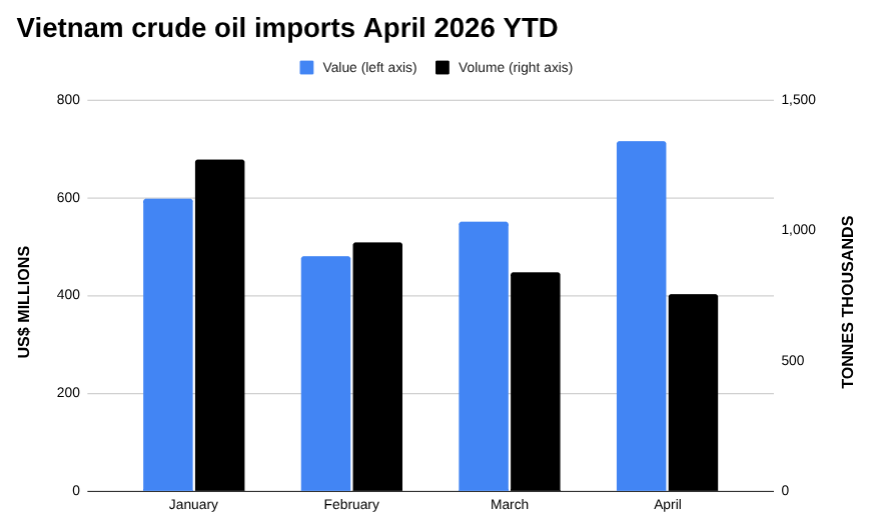
Notably, before the war, Kuwait accounted for around 85 percent of Vietnam’s crude oil imports; these imports have now fallen to zero.
Other supplies, however, have been sourced elsewhere, though customs data doesn’t make clear where that oil is coming from. It was, however, reported that Japan was arranging for 4 million barrels of crude to be made available, roughly the equivalent of 546,000 tonnes.
China has also reportedly been making oil available from its reserves to several Southeast Asian nations, including Vietnam.
As far as costs go, the spike has been sizable.
In February, Vietnam spent US$480.8 million on crude oil imports, rising to US$715.9 million in April.
On a per tonne basis, that’s a shift from US$503.60 to US$948.06, almost double.
Gasoline and diesel fuel imports were up in value but down in volume.
Imports of gasoline and diesel were down 27 percent since February, but were up 74.5 percent in value.
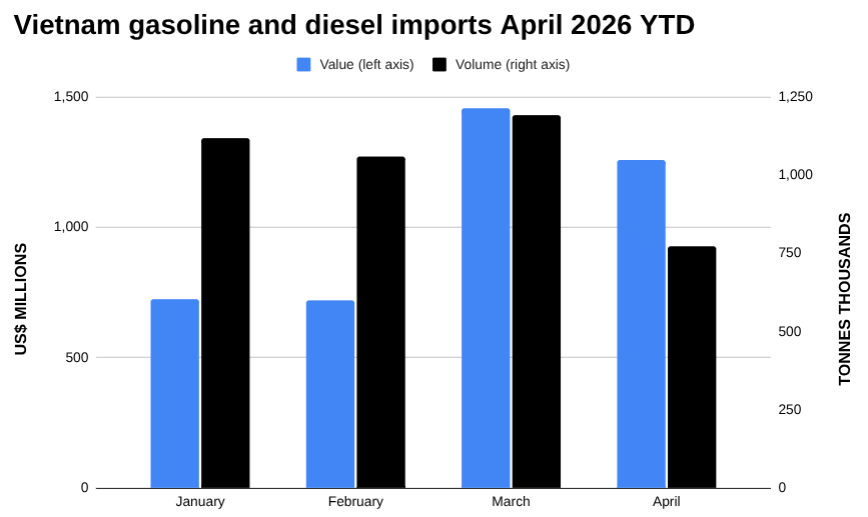
Interestingly, in April, Vietnam imported 771,932 tonnes of gasoline and diesel for US$1.26 billion. Using a back-of-the-envelope calculation, assuming a conservative estimate of 1,340 litres of fuel to the tonne, Vietnam paid about US$1.25 a litre or VND 33,019.
The average price of a litre of diesel in April, however, was VND 32,237 (US$1.22), with standard petrol, RON95, averaging VND 23,911 (US$0.91) a litre, highlighting the pressure regulated fuel retail prices are putting on fuel distributors and retailers’ profit margins.
Notably, Petrolimex, the country’s biggest fuel distributor, reported a first-quarter loss of VND 662 billion (US$25.1 million) in Q1, citing the mismatch in government-mandated retail prices and input costs.
Liquefied petroleum gas (LPG) import volumes have increased.
Where petrol, diesel, and crude oil imports have seen a fall in import volumes, LPG has seen a considerable climb, reaching 427,243 tonnes in April, about 39 percent higher than in February.
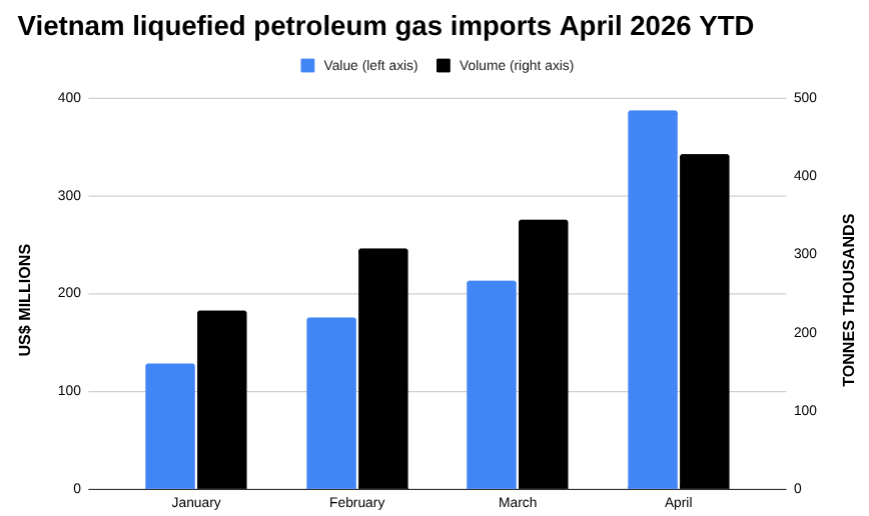
The cost of those imports has also continued to climb. In February, importers were paying about US$569.41 a tonne, but by April they were paying US$905.85 a tonne.
Commonly used for cooking, LPG has a considerable direct impact on consumers. It also contributes indirectly to inflation through higher food preparation costs.
Of note, in April, eating out prices jumped 1.94 percent month-on-month, and are now up 8.3 percent year-on-year, according to Vietnam’s Consumer Price Index.
Coal has seen an increase in both price and volume.
The per tonne cost of imported coal has shown steady, though relatively modest, month-on-month price increases. Vietnam paid US$108.77 a tonne in February, with the per tonne cost rising to US$114.16 in April.
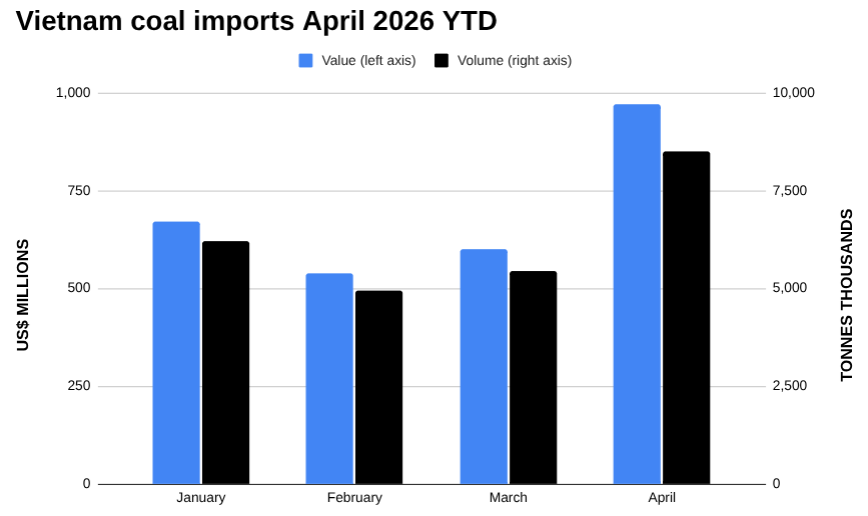
The higher price aligns with a broader spillover into the energy sector as economies search for alternative energy sources, with electricity being one of the most readily available.
In terms of volume, coal imports were up roughly 72 percent in April over February, though this is in line with an increase in power consumption heading into summer. Year-to-date, it was also only up 2.9 percent year-on-year.
The value of other petroleum products has more than doubled.
The biggest percentage increase in energy product imports in terms of value was other petroleum products.
It’s not clear exactly what these products are — Vietnam Customs doesn’t publish its data by HS code, only description — but the value of these goods has increased about 128.61 percent since February.
The data
Vietnam energy imports value (US$) April 2026
| January | February | March | April | |
| Liquefied petroleum gas | 127,801,753 | 175,091,574 | 212,938,021 | 387,019,334 |
| Coal of all kinds | 669,273,580 | 538,636,071 | 601,384,791 | 970,881,254 |
| Crude oil | 598,130,266 | 480,789,714 | 549,680,477 | 715,912,776 |
| Gasoline and diesel fuel of all kinds | 722,793,505 | 720,783,423 | 1,455,394,197 | 1,257,499,982 |
| Other petroleum products | 181,747,252 | 246,289,838 | 176,210,356 | 563,041,815 |
Vietnam energy imports volume (tonnes) April 2026
Note, there is no volume data for other petroleum products.
| January | February | March | April | |
| Liquefied petroleum gas | 227,809 | 307,499 | 344,622 | 427,243 |
| Coal of all kinds | 6,206,632 | 4,952,061 | 5,427,076 | 8,504,664 |
| Crude oil | 1,270,633 | 954,713 | 839,291 | 755,133 |
| Gasoline and diesel fuel of all kinds | 1,119,126 | 1,057,951 | 1,191,770 | 771,932 |