
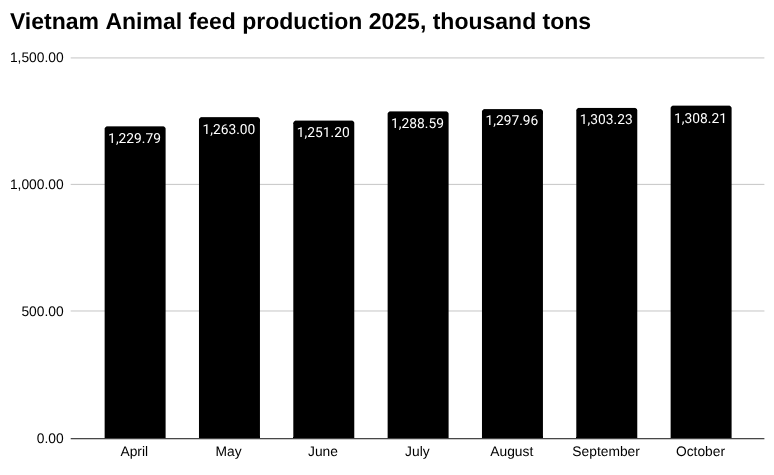
Vietnam produced 1,308.21 thousand tons of animal feed in October, up 0.38 percent from 1,303.23 thousand tons in September, according to the latest data from the National Statistics Office.
Over the first ten months of the year, output reached 12,434.56 thousand tons.
Listed animal feed companies
Dabaco Group JSC
Dabaco Group JSC (DBC) operates across animal feed production, livestock farming, and food processing in Vietnam.
DBC closed at VND 27,200 on Monday up 0.2 percent with 51,250,000 shares traded, worth VND 140,030 million.
Foreign ownership in DBC is currently capped at 49.0 percent, with current foreign ownership sitting at 2.3 percent.
BAF Vietnam Agriculture Joint Stock Company
BAF Vietnam Agriculture Joint Stock Company (BAF) engages in animal husbandry and feed production, including bran and feeds for pigs, alongside processing and pork-meat production.
BAF closed at VND 32,000 on Monday up 0.2 percent with 14,751,000 shares traded, worth VND 47,204 million.
Foreign ownership in BAF is currently capped at 50.0 percent, with current foreign ownership sitting at 2.8 percent.
Explore opening a trading account in Vietnam→
Vietnam animal feed industry news
Netherlands’ firm floats agribusiness project in Tay Ninh
Dutch agribusiness giant Royal De Heus reportedly plans to invest around VND 10 trillion or US$384.6 million in a chain of high-tech agricultural projects in Tay Ninh with local partner Hung Nhon Group.
The 2025–2030 plan includes 12 projects covering feed production, seed development, livestock farming, processing and export, aiming to generate about US$2 billion in value by 2030.
See the latest Vietnam news headlines→
Vietnam’s animal feed industry
Vietnam’s animal feed industry has expanded rapidly in response to rising demand from the livestock and aquaculture sectors.
The market is driven by both domestic producers and major foreign-invested firms, supported by continued growth in meat, poultry and seafood consumption.
Feed production is concentrated in key agricultural provinces, with manufacturers relying heavily on imported raw materials such as corn, soymeal and wheat.